Contrary to yesterday, today was a pretty good day. Had a decent breakfast (including warm pain au chocolat 😋).
After breakfast I took myself off to Singapore’s Botanic Gardens. The gardens are 166 years old, a UNESCO World Heritage Site and Asia’s “top park attraction” (according to trip advisor).
Which makes it all the more satisfying that entrance to the majority of the gardens is free. You could spend several days here exploring all the different areas.
The one area that is chargeable is the National Orchid Garden. Even this is only S$15 (11€, £10), so less than half the price of the rubbish observation deck from yesterday.
And a million times more impressive.
Let’s Talk About Orchids
When I was in school, we were told that an orchid was a flower, singular, and so rare that because we’d never go to tropical South America, we would never see.
Orchids were described to us as some almost mythical plant that we’d only see in textbooks.
Bull. Shit.
Of course, as I grew older I realised that orchids were a broad species and found all over the world. But still, learning about the numbers, distribution, growing and propagating methods, and the sheer variety of them was eye-opening.
Did you know:
There are around 28,000 species of orchid.
There are a kind of herb.
Their seeds are microscopic, and don’t contain enough nutrients to germinate, requiring a symbiotic relationship with fungi to provide the necessary fuel.
Vanilla extract comes fromVanilla planifolia, a species of orchid native to Mexico, Central America, Colombia, and Brazil.
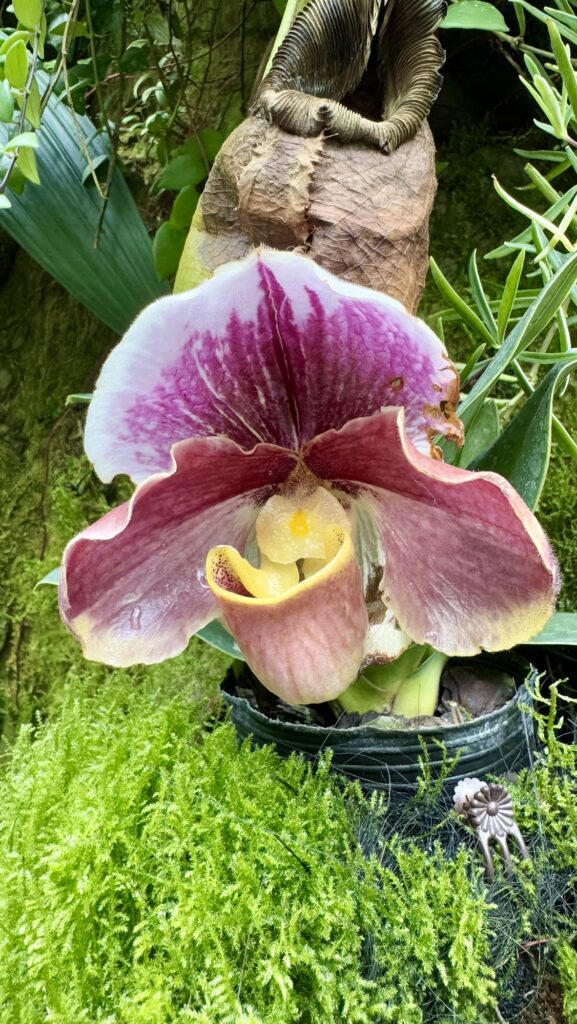
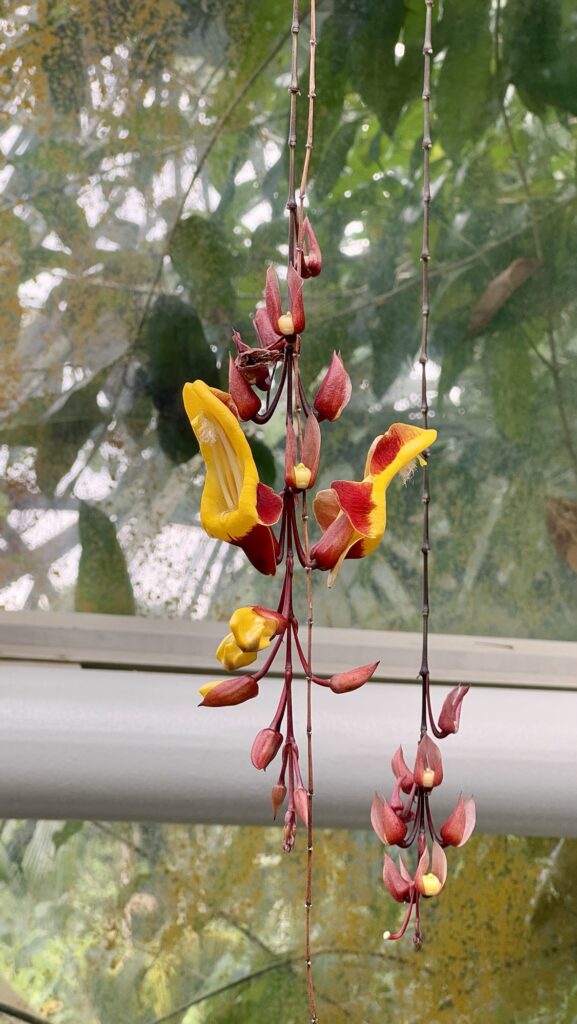
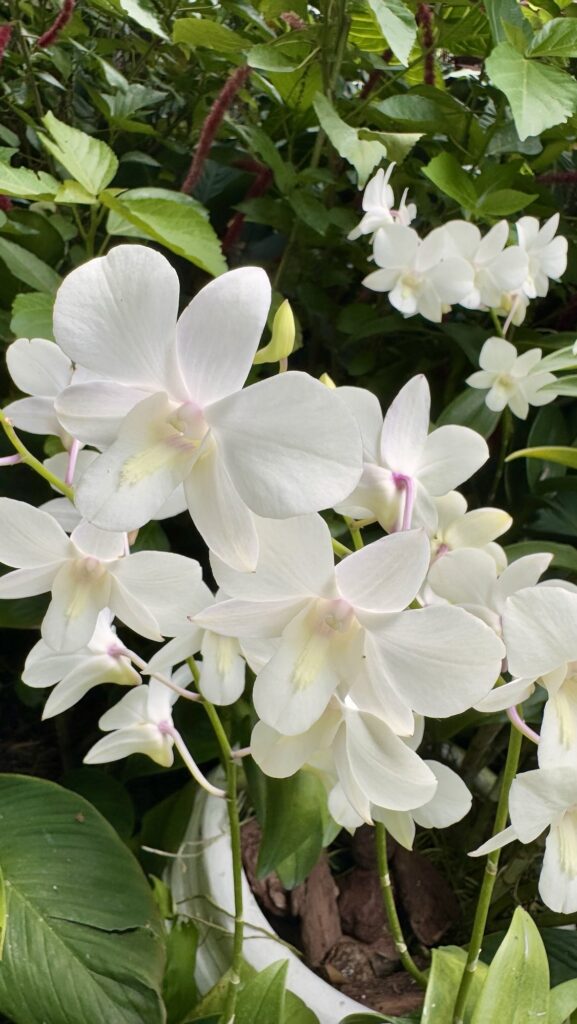
And so on and so on. I took so many pictures I’ll put them all in a separate gallery.
Really, I could have spent more hours here than I did, taking photos of hundreds of different varieties that I didn’t know the name of.
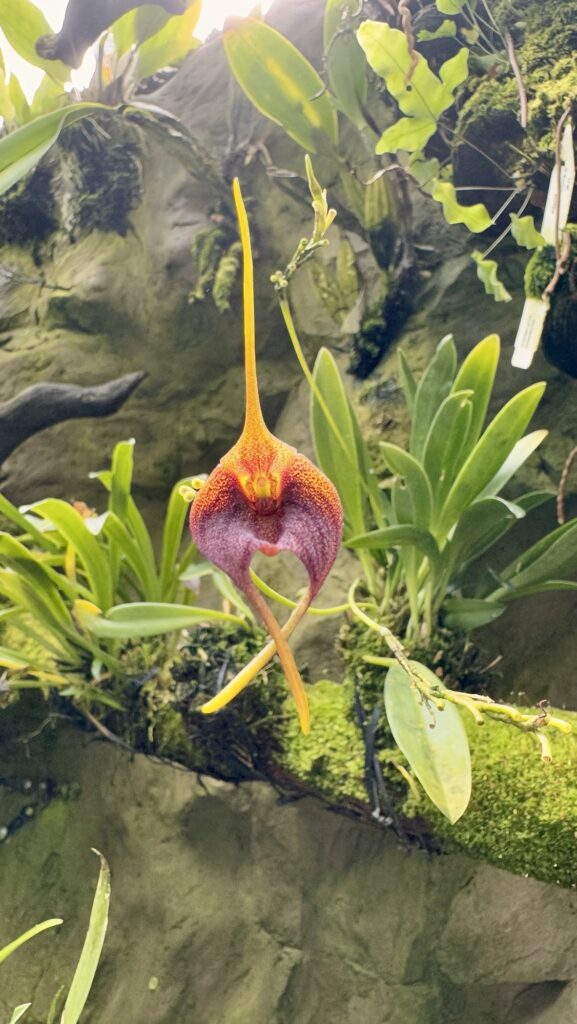
Dendrobium Memoria Princess Diana (seriously)
However, a) my phone was dying in the heat (the chilly “Cool House” was a blessed relief) and b) I had to find stamps.
Singapore Post
Singapore’s national postal service has the most “1980’s C&A Skiwear” brand logo.
You can feel the shoulderpads.
Since the MTR station was near a mall with a branch in it, I thought I’d try my luck with stamps there. They had a vending machine that had a couple of options and, seeing no other outlet, I tried it out.
Result: minus S$5.20 and plus zero stamps. The error message was in Chinese so after tapping every button on screen I gave up and went to the counter. “Oh yeah. You’ll need to ask for a refund via this website [points to QR code],” like this happens regularly.
“And we only print standard POS stamps here. You need to go to the GPO where they have a philatelic shop.”
Off I traipse. And the GPO shop is rather nice. You browse the stamps, choose what ones you want and quaintly write down the codes on a piece of paper like you’re in Argos, and then someone fetches them from a cupboard.
I rather went overboard so I hope I’m not fuelling my mother’s habit again. Maybe I’ll drip-feed them to her over a few months 😅
And That’s Almost It 😭
Tomorrow morning I head back to Changi T3. There I’ll board a Singapore Airlines Airbus A380, and I’m not ashamed to say that that aircraft is part of the reason I’m even in Singapore.
I figured that airlines were phasing out usage of the A380 and really only Emirates and SingAir were still committed to them. Seems there’s been a post-pandemic revival in fortune and some are being brought back into service by (e.g.) Lufthansa.
Anyhoo, here’s my chance to fly this super-big-boy plane. And with wifi, so my last post for this trip may be from 10km straight up.
By any rational measure, Singapore should be a near-ideal city/state for me:
Good, cheap public transport (including driverless underground trains where you can see right down the tunnel ahead).
Spotlessly clean streets and gardens.
Wide interplay of cultures and cuisines.
English as one of their official languages.
And yet. I’m missing something. Maybe I just had a bad day.
I went to a “recommended” cafe for breakfast that turned out to be a Starbucks-like chain, and where my reheated sandwich was still partly chilled.
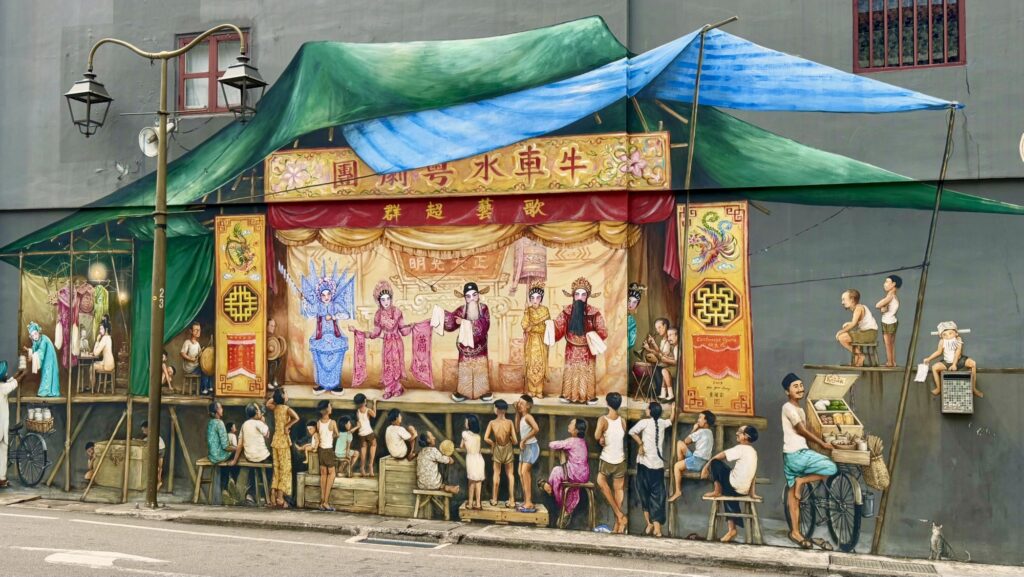
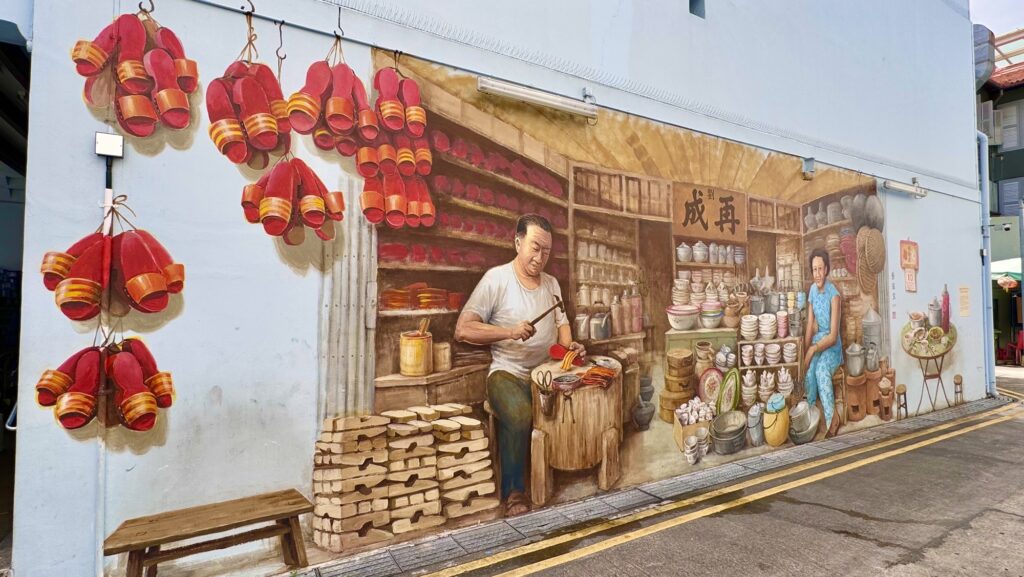
I took a bus and underground to Chinatown expecting to see some evidence of its historic past, but found a tourist market and some (nice) artwork.
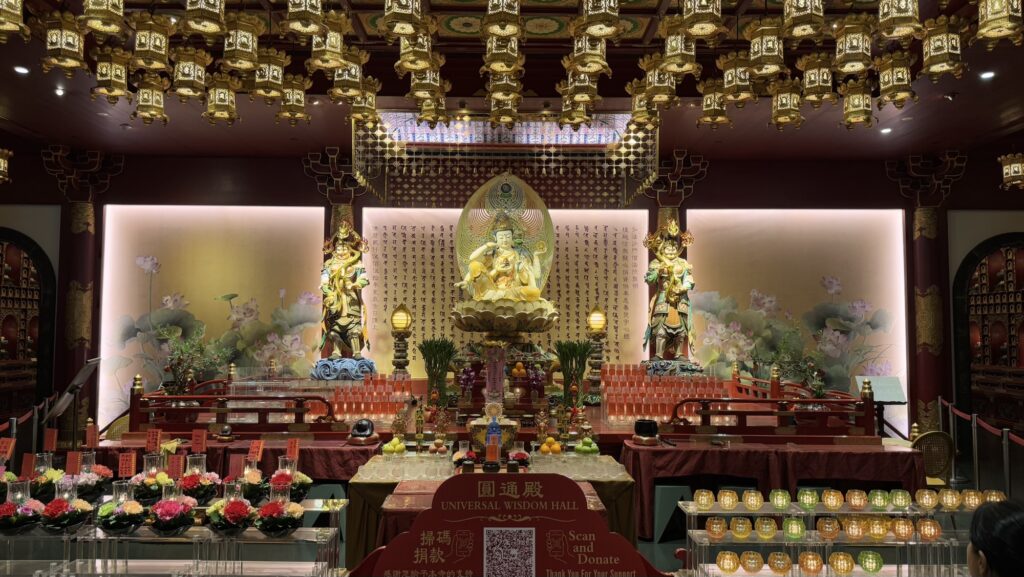
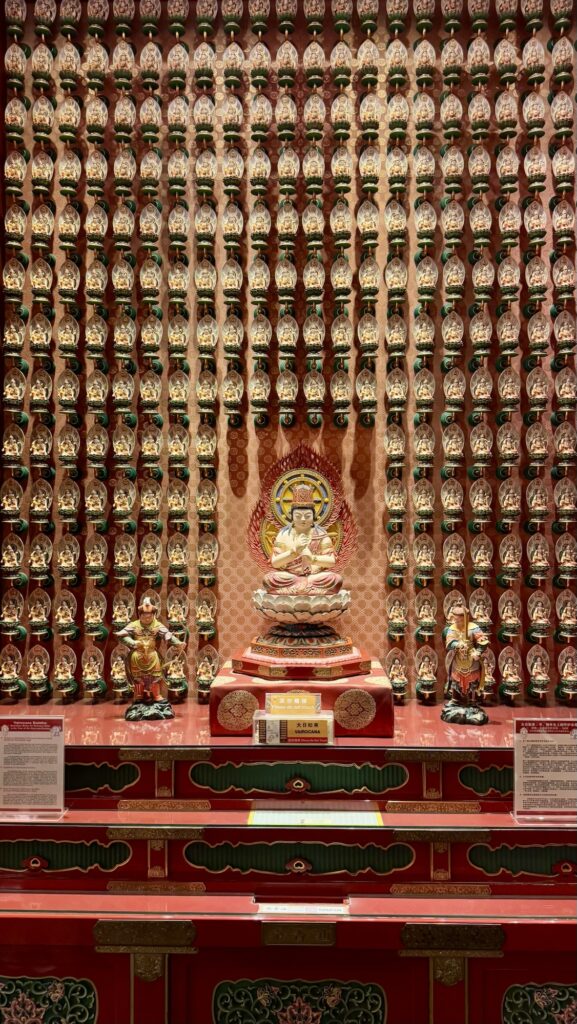
The abundant gold leaf in the Buddhist temple felt a bit excessive next to the pleas for donations.
Everything felt like it was a bit sanitised and tourist-friendly. Except then I decided (against my initial instinct) to do a tourist-favourite attraction, the so-called SkyPark perched on top of the Marina Bay Sands hotel towers.
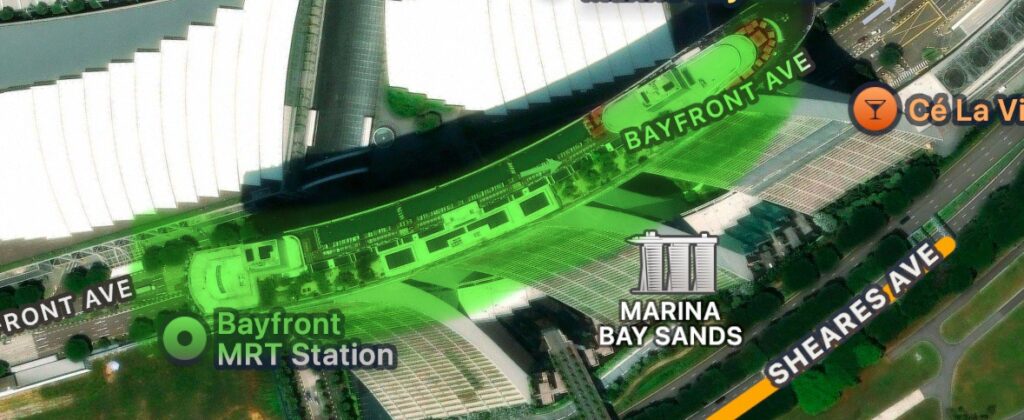
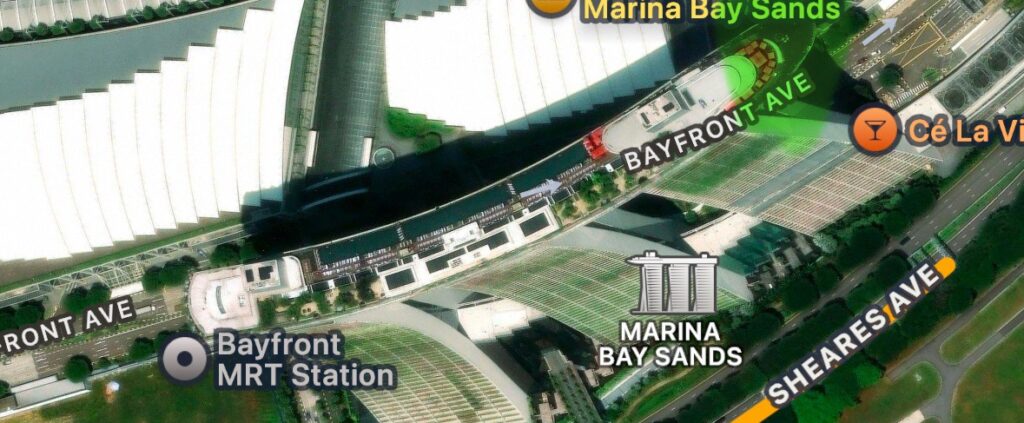
Roughly, the deck at the 56th floor looks like this, a slightly curved sweep across the three towers of the hotel.
And for S$35 (25€, £21) you can visit, well, a tiny part of that deck, on the right-hand-side here:
All the rest of it is either for hotel guests only (like the infinity pool, fair enough) or for other access uses like a restaurant. You get to explore an area about 30×20 metres. It all feels like a bit of a con. I eked out twenty minutes up there, half of which was trying to shelter from the intermittent rain.
It left a bad taste in my mouth and a general ambivalence toward any of the other attractions in the area (all costing similar sums).
Hawker Redemption
It’s not all bad though, by any means. I had a late lunch at a hawker place near my hotel.
(“What’s a hawker place?” I hear you ask. Basically, a food market, like an indoor market in the UK but mostly with small, independent food outlets.)
I dutifully ordered my food, waited for it to be prepared and then went to pay with card.
Oops. Only QR or cash.
I don’t have cash (didn’t think it necessary here), and QR only works for locals.
“It’s OK,” says the guy. “Eat your food, then there’s a cash machine just over there. I can keep tabs on you because you’re so tall and also the only white guy around.”
There’s still a place for trust and honesty here 🙂
After another early start I was ridiculously early to the airport in Siem Reap for a short flight to Singapore.
Relatively few people on the flight, maybe 40% full. Somehow I’d landed first row, 1F so was on and off ahead of the crowd.
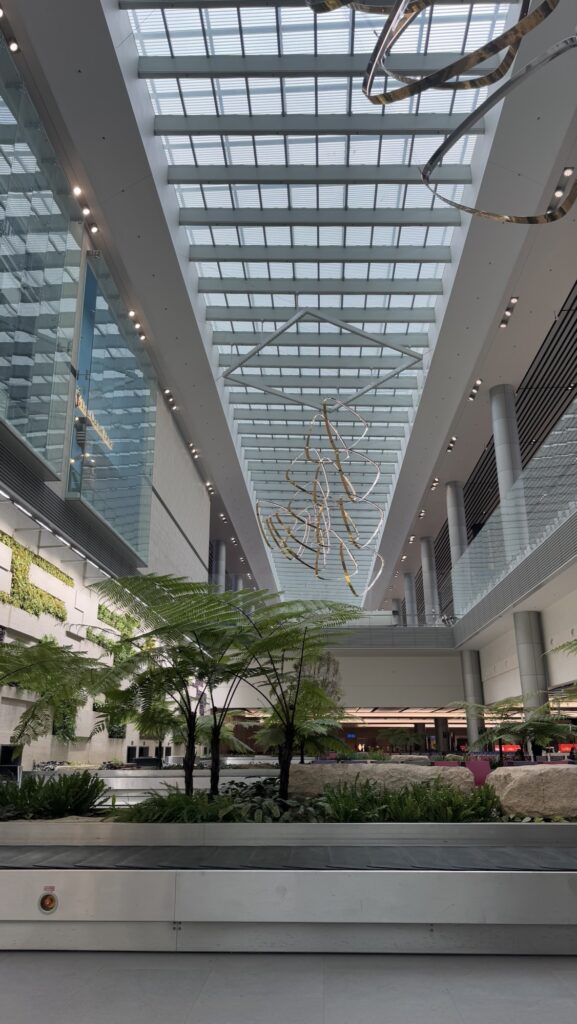
Terminal 4 at Singapore’s Changi airport is designed for low-cost airlines but has the look of a modern, high-class terminal. Even something as mundane as the baggage retrieval conveyors are a nice place to be.
The other novelty on entering Singapore is that (having completed your pre-arrival information online) you can swan through an automated immigration gate, never having to be interrogated by border agents. The downside is that you don’t get a stamp in your passport.
The Jewel
A cursory glance at Changi airport’s website will quickly make obvious that it’s not just an airport, it’s a destination.
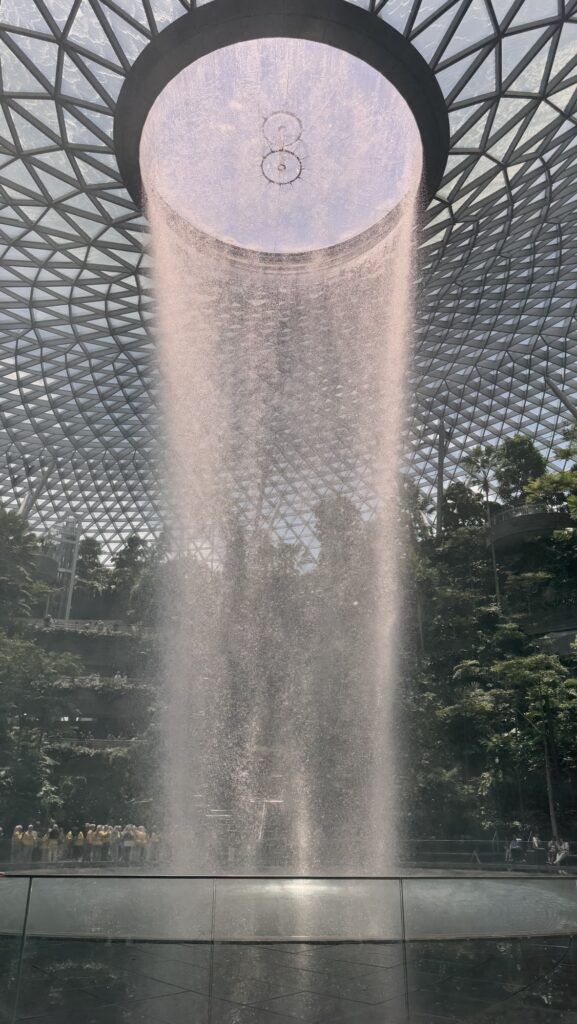
What this effectively means is that nestled between Terminals 1, 2 and 3 is a huge luxury shopping centre, and the centrepiece of the centre is the Rain Vortex. As “the world’s tallest indoor waterfall”, up to about 40,000 litres of water per minute fall from the glass ceiling to the basement level. It’s undeniably impressive, but not something I spent much more than 10 minutes gawking at.
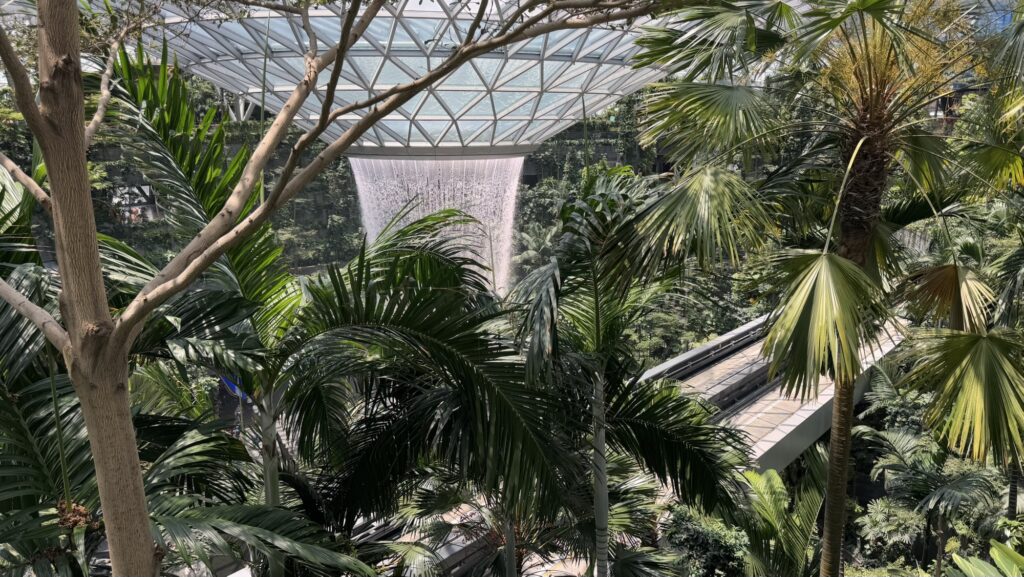
What I actually found more compelling was the Forest Valley areas, where thousands of shrubs and trees climb terraces around the waterfall.
The rest of the affair is rather pedestrian, just a luxury mall wrapping the fancy waterfall and gardens, and a few pricey tourist attractions mainly aimed at kids.
The Hotel Indigo
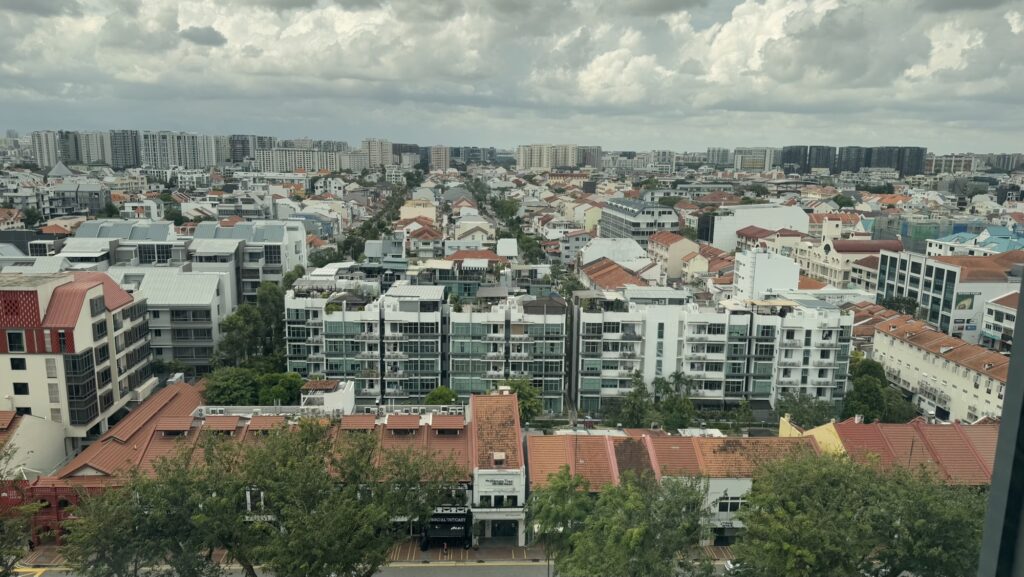
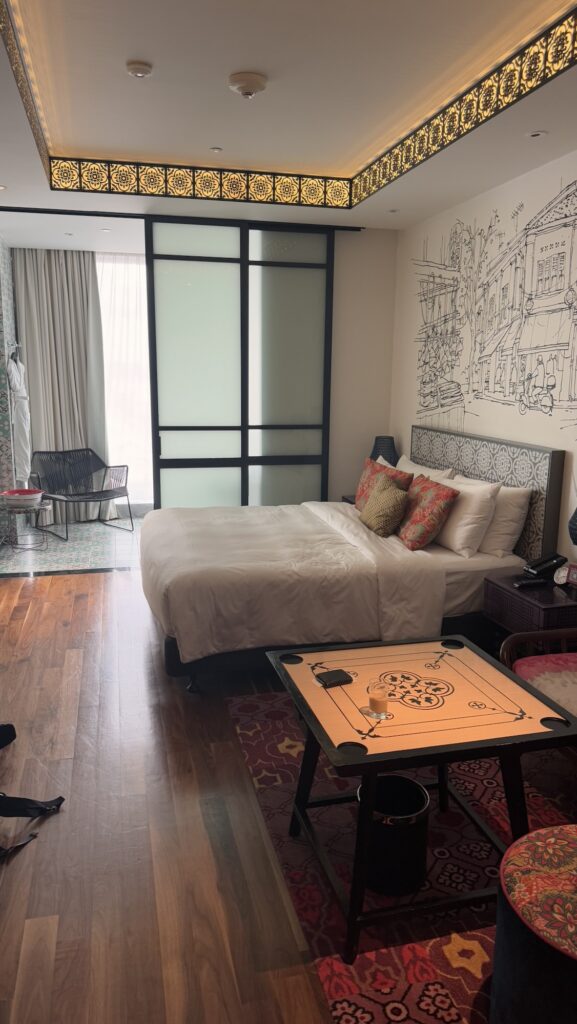
Finding a half-decent, reasonably-priced hotel with a window is not easy in Singapore. Only through a clever combination of my employer’s corporate code and being an IHG member did I settle on the Hotel Indigo Singapore Katong. It’s really nice, and that membership thing got me a room upgrade, that looks out over the city from the floor-to-ceiling windows in the bathroom.
Gardens By The Bay
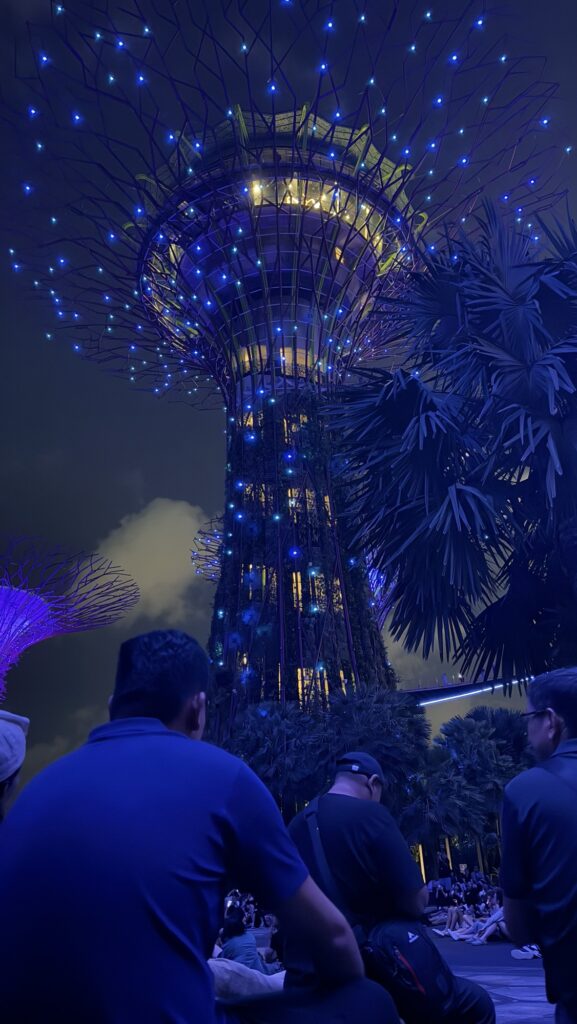
Another of Singapore’s top tourist attractions, I took a look in the evening after dinner. Again, there are paid attractions to visit, but wandering around is free and I was just in time for the twice a nightly “Garden Rhapsody” which was a medley of opera classics booming while the huge metal trees (designed as ventilation for other buildings) swim in LEDs. It’s ever so slightly on the wrong side of classy.
Still, there’s more to see there so I’ll try to get back in the daytime and have a proper mooch about.
My mother was a stamp collector, but since she downsized there was no room for all the stamp books and related paraphernalia.
She still likes to look at different stamps, so I’ve bought a couple from every country I’ve been to (except Vietnam, since I could never find an open post office).
So that was my only mission today, and completed in about 30 minutes leaving the rest of the day to get a bit sunburnt by the pool and eat a pizza. What cultural highlights.
Early start tomorrow to fly to Singapore. I’m expecting something very different.
It’s hard to start writing about my experiences at Angkor without resorting to trite superlatives. I had no real expectations, other than I knew I would see what’s stated to be the world’s largest religious monument, Angkor Wat. Of course I’ve seen pictures, mostly of stunning sunrises and sunsets.
Nothing prepared me for the scale, intricacy and (to use an appropriate term) majesty of the site as a whole. Angkor is more than just the Wat, prime draw as that is. With a history stretching from the 9th to 15th centuries, it’s a testament to the millions of people who lived across at least 1000 square kilometres, site of the founding of a kingdom and a complex interplay between Hindu and Buddhist religions.
As soon as a good connection allows, I’ll post many (many) pictures I took across two days in a separate gallery, but I’ll summarise here the places I visited.
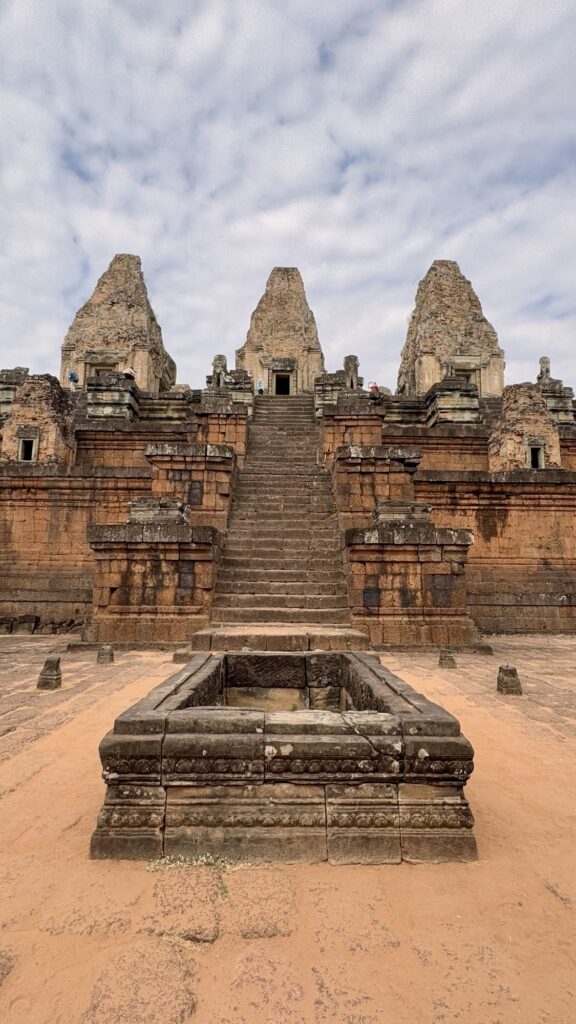
Pre Rup Temple
Completed 961 AD for Rajendravarman II. Dedicated to Shiva, the Hindu God of Destruction.
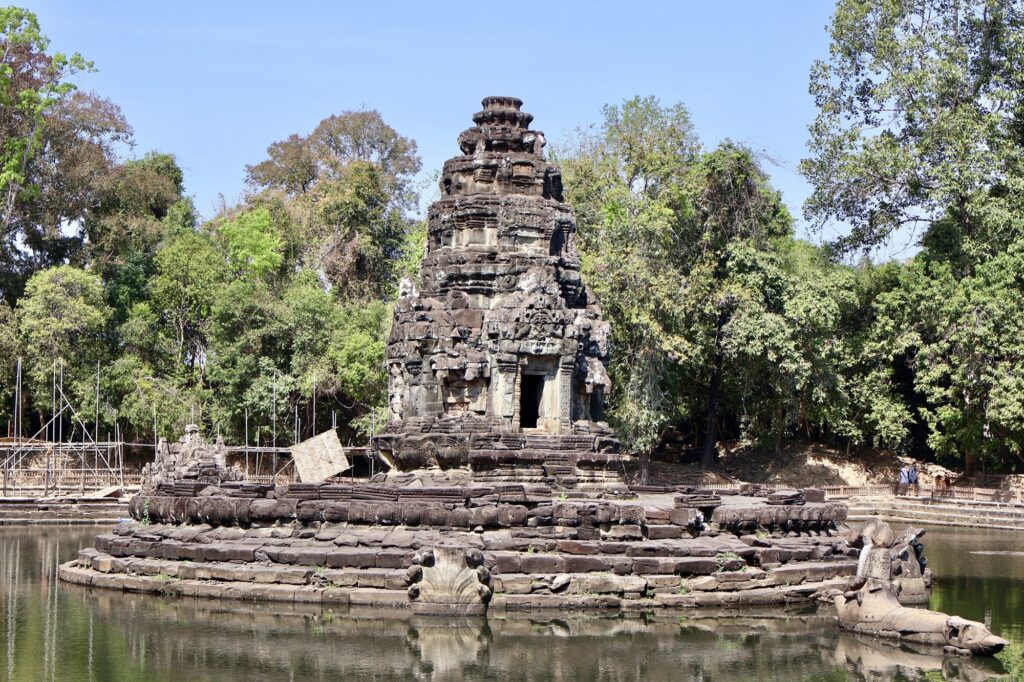
Neak Pean, the Entwined Serpents
Completed second half of the 12th century for Jayavarman VII. Dedicated to Avalokitesvara, the Buddhist Lord who looks Down.
Accessed across a vast man-made moat, this temple includes five pools, four small at polar points around a larger central pool. The four pools represent the four elements, wind, fire, water and earth, and each is guarded by their representative animal, elephant (north), bull (east), horse (south) and lion (west).
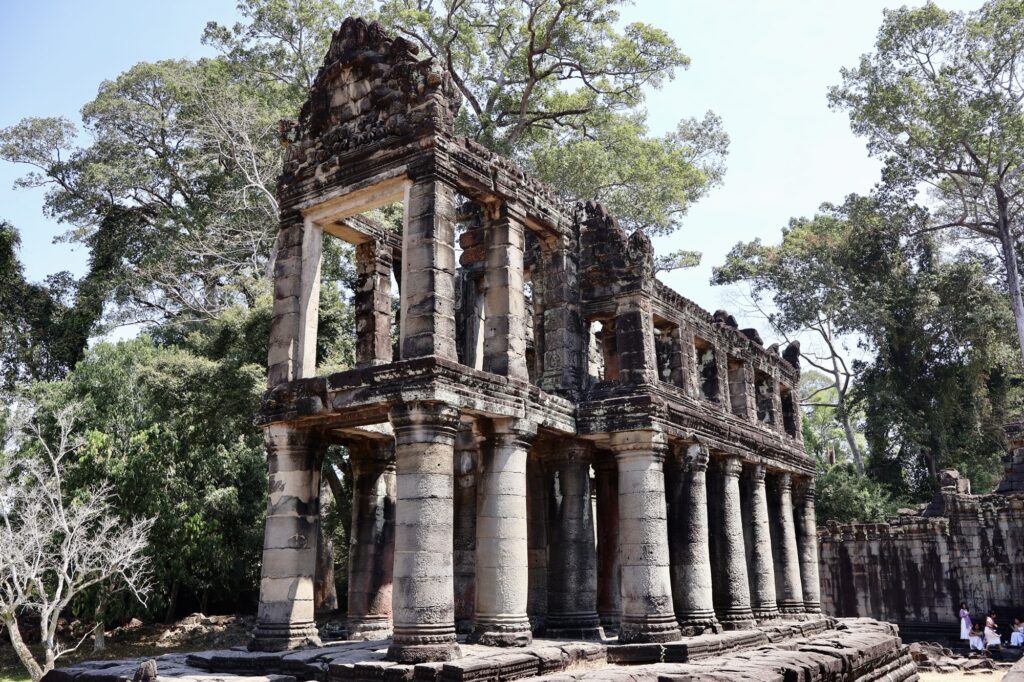
Preah Khan, the Royal Sword
Completed 1191AD by Jayavarman VII to honour his father Dharanindravarman II. Buddhist with later Hindu influences.
Principally an administrative and learning centre, this temple can be considered a university complete with library and study halls.
Library.
Banteay Srei
Completed 967AD by courtiers Vishnukumara and Yajnavaraha. Dedicated to both Shiva and Vishnu.
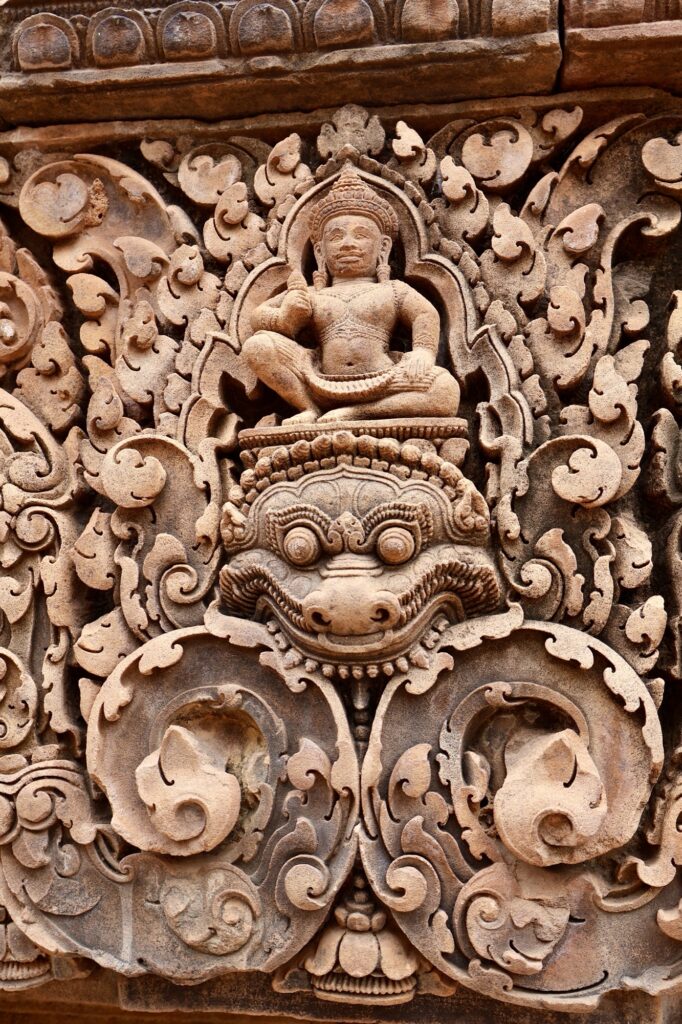
Unusually for Angkor temples, this is constructed of red sandstone which is easily carved and hence has intricate decoration.
Phnom Bakheng
Completed 889–910 AD by Yasovarman I. Dedicated to Shiva.
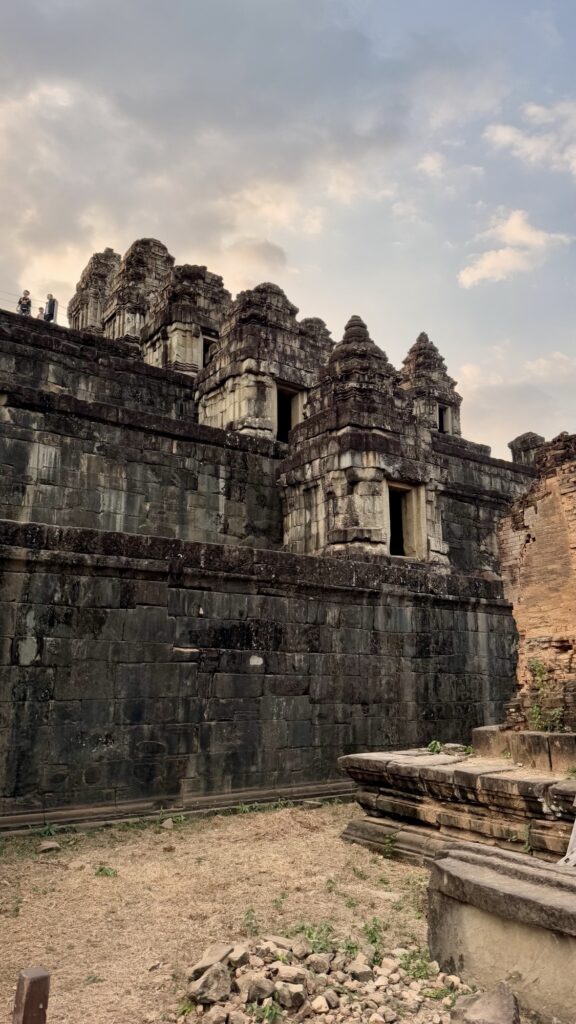
Raised high on a hill, symbolising Mount Meru, home of the Hindu gods, this is perhaps the second most-popular site for watching sunsets in Angkor.
Angkor Wat
Completed 1150 AD by Suryavarman II. Dedicated to Vishnu, the Hindu God of Preservation.
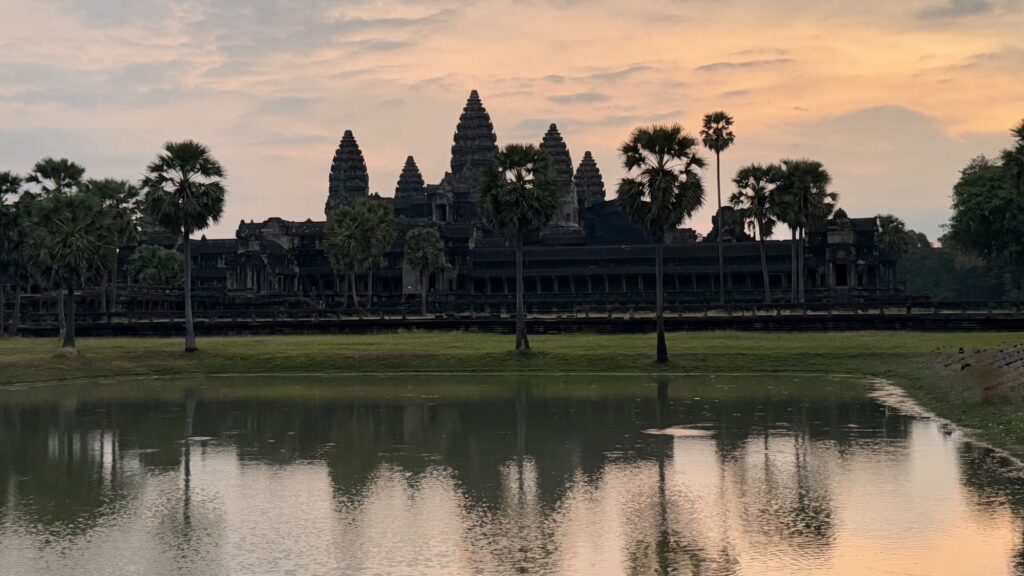
Obviously the most famous, this is a simply enormous temple, surrounded by a 5km lake and with outer walls 3.6km. It rises on three levels with five towers at its centre.
Ta Phrom
Completed 1186 AD by Jayavarman VII to honour his mother. Dedicated to Prajnaparamita, the Buddhist principle of Perfection of Transcendental Wisdom.
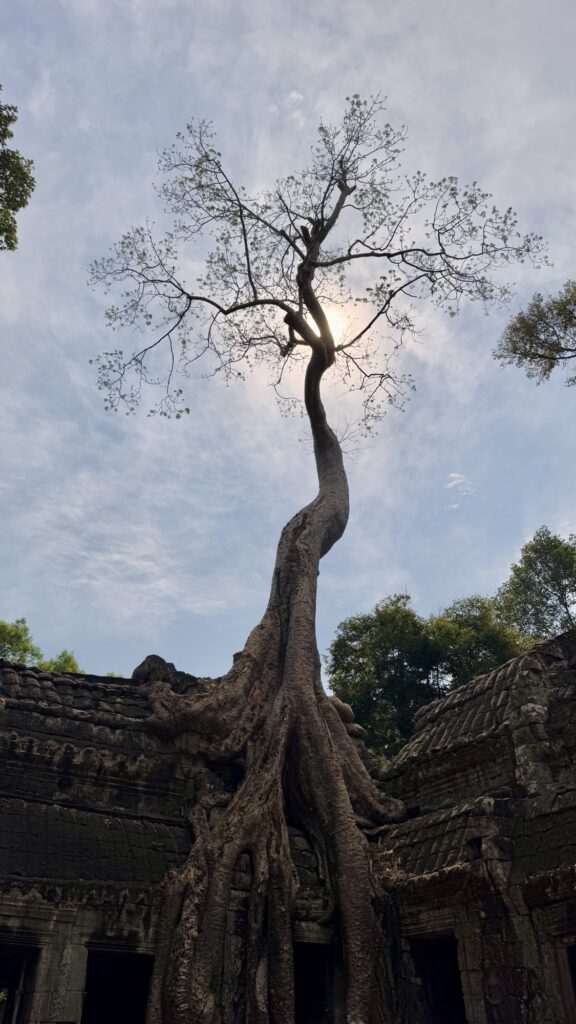
Most famous as the “Tomb Raider” temple, this was abandoned when the Khmer empire collapsed, and was left to decay as nature reclaimed the site. Enormous thitpok and strangler fig trees have grown over the site.
Angkor Thom
Established late 12th century by Jayavarman VII as the capital of the Khmer empire.
More a city than a temple, likely to have sustained around 100,000 people, one in every ten-thousand people alive at the time lived here.
Bayon
Completed late 12th century by Jayavarman VII. Dedicated to both Hindu and Buddhist deities.
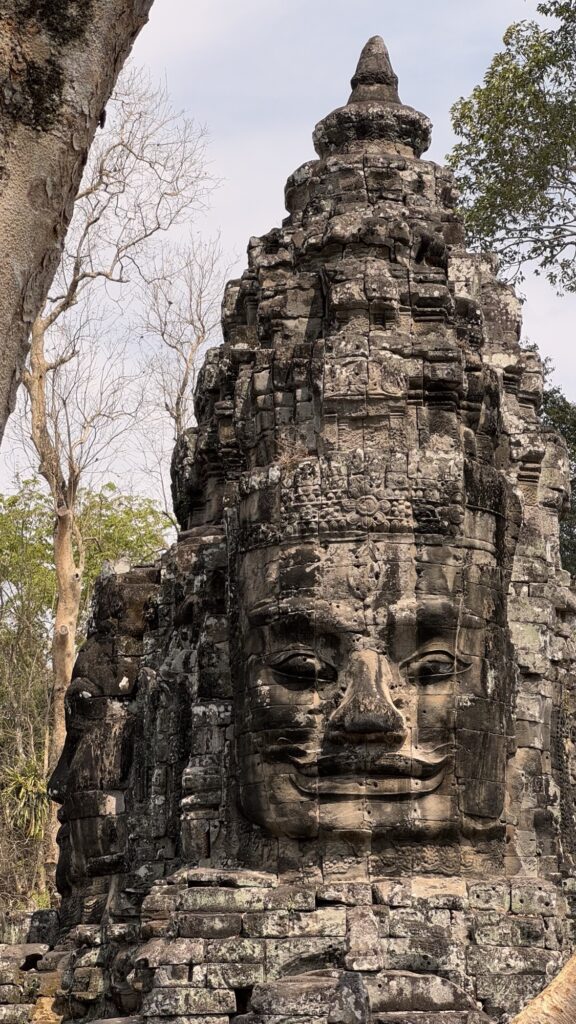
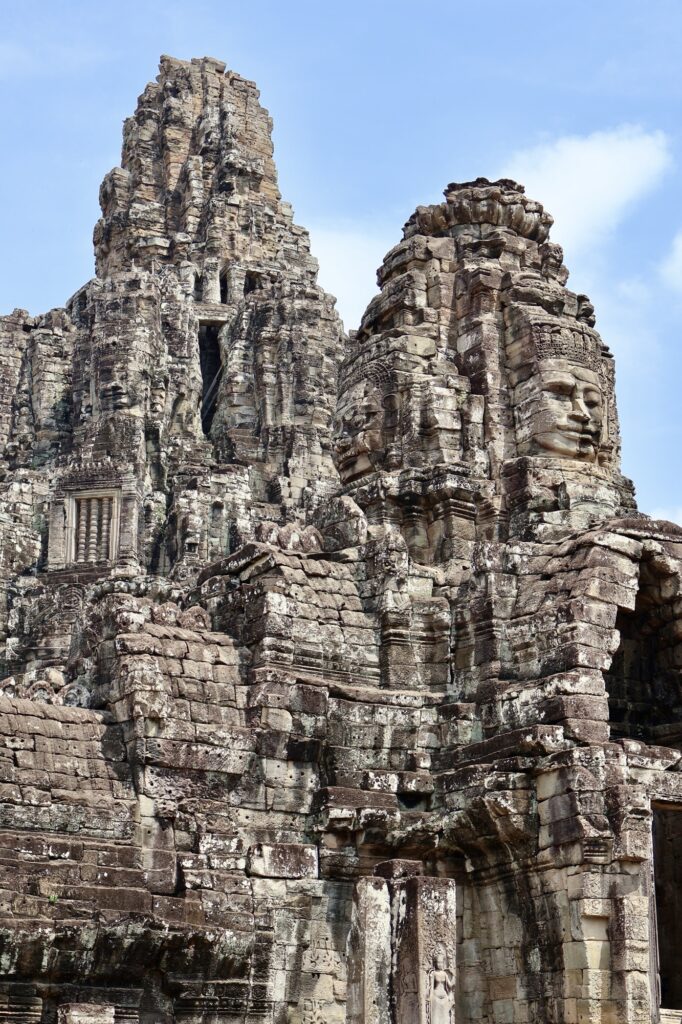
Famous for having around 200 carved faces on 49 towers, this site also features vast gallery walls depicting everyday life and historical events from the Khmer empire.
Having left Chiang Mai behind, it’s Siem Reap for a few days. My flight from Bangkok was delayed and I was a bit worried about getting through visa processes and immigration in time for my booked transfer from the airport (the new airport is quite some distance from the city), but all worked out.
Siem Reap
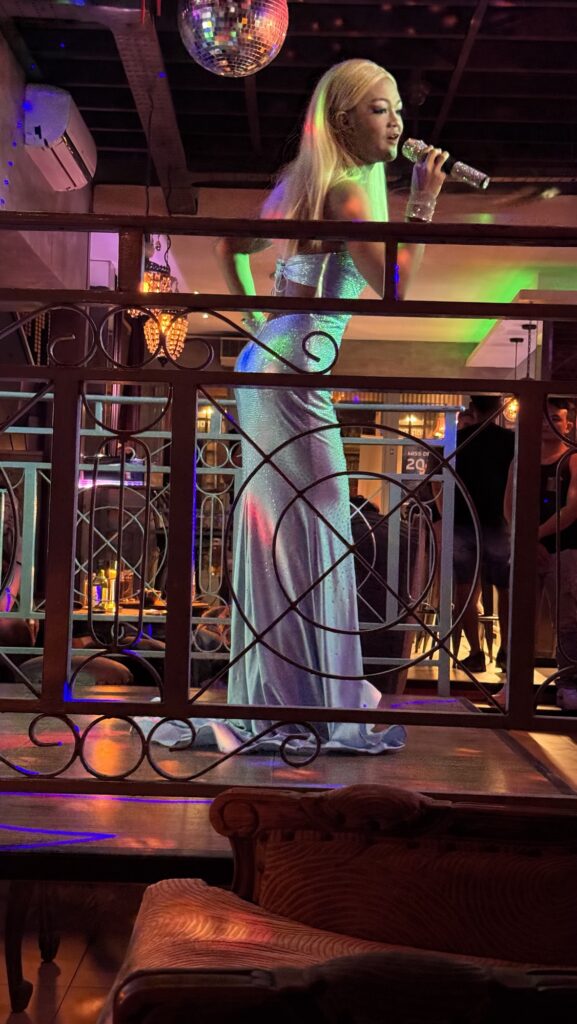
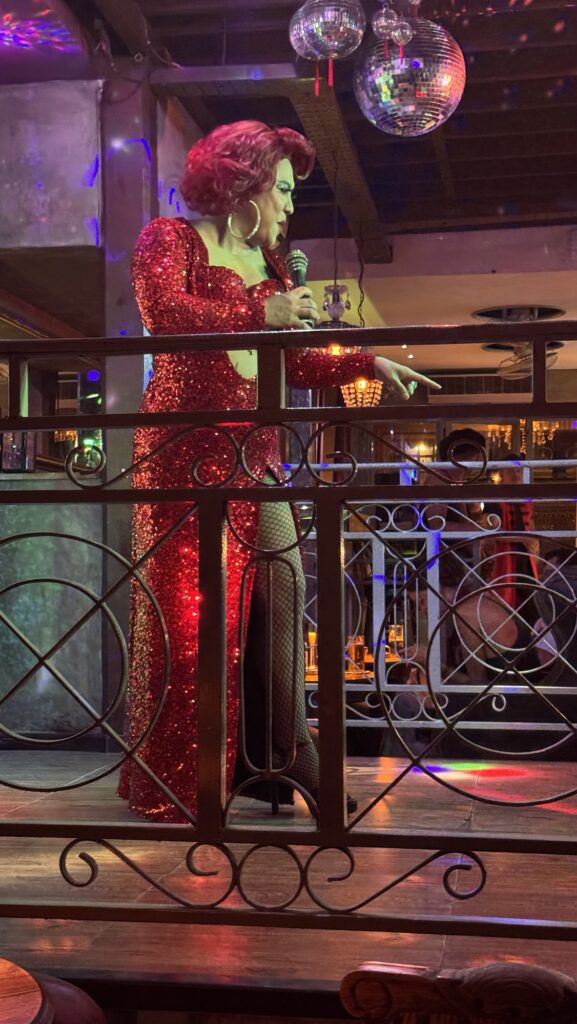
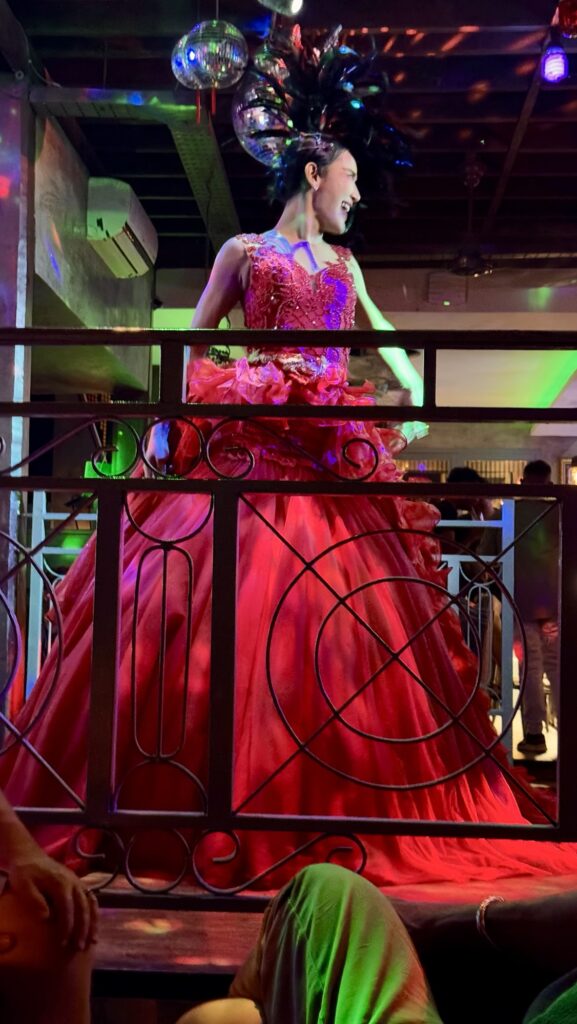
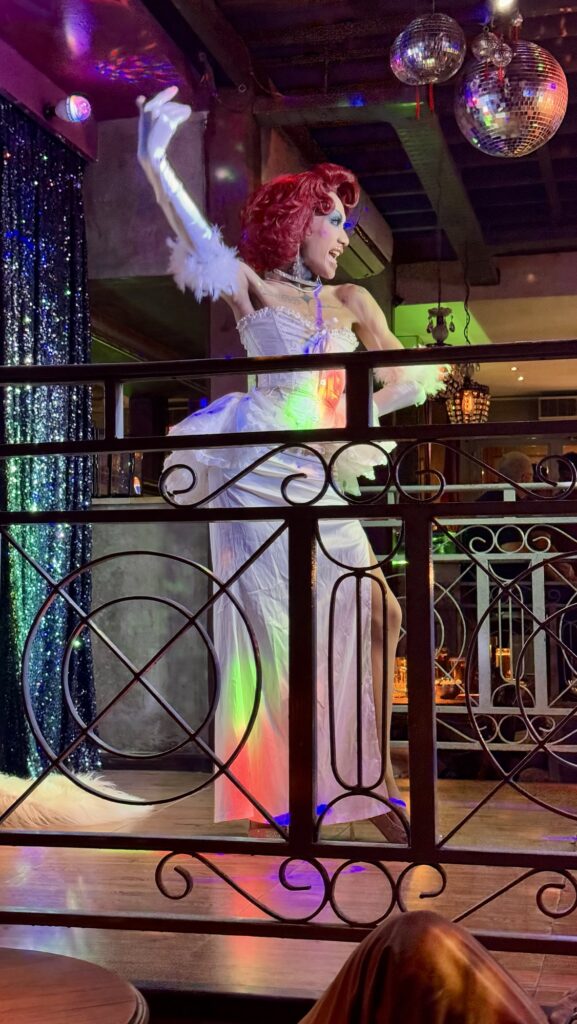
… is not quite what I expected. Yes it has a night market and a “Pub Street” but also a smattering of rainbow bars, one of which (Bar Code, familiar to some from Europe) had an entertaining drag show going on.
I don’t have the time or patience right now to add pictures (since it’s already a day ago when I’m writing this), but will do later.
(Edit: here you go)
Tomorrow (today, actually), is first day of two in the ancient city of Angkor and its surroundings. I’ll do a joint post for that with about a million pictures.
Hmmm. I tried again to find the hipster street west of the old city. But I went via the Lanna Traditional House Museum. This is an area of the Chiang Mai University grounds where there is a small collection of wooden houses from across many years, typical of the kind found in northern Thailand.
It was pretty interesting (not super interesting, because for each house there’s only a short paragraph about when and how it was built).
Obviously the houses were not all conveniently built in the grounds they’re in now, but it illustrates how (relatively) easy it is to deconstruct a wooden house, and move it elsewhere. I’m not actually sure if you can do that with a Huf Haus but still.
When that was done I thought about the hipster street, decided I was already too sweaty (very humid here the past two days) and went back to my hotel.
For there I needed to shower before my most important activity of the day: a 90-minute traditional Thai massage. Thai massage (I learned) is considered by UNESCO as an Intangible Cultural Heritage and ninety minutes of it sure did something tangible to all those muscles I’d grittily tightened during eight days of riding around Laos. It was so good. Normally I’d hate going to a fancy spa-massage place but this was lovely and good use of 40€.
Of course one can get a massage from any number of roadside establishments for a lot less but I felt I needed pampering and indeed I was.
Final night in Chiang Mai so nothing crazy this evening, just a nice meal (two dishes, actually) at this local place I like and the chance to talk briefly with a very solid piece of German manliness, who told me that while he was on Koh Phi Phi he’d drunk twelve beers and then taken part in an amateur Muay Thai fight.
Reader, I was smitten (but he was straight so y’know, I’m not married yet).
Laos is a beautiful, landlocked country in Southeast Asia. While by no means an unknown destination, it is relatively less travelled by tourists than its neighbours of Thailand, Vietnam and Cambodia. This is a shame, because it offers some spectacular scenery, warm-hearted – if, in many cases, brutally poor – people, and exceptional value-for-money for all kinds of visitors from backpackers to rather more well-heeled folk. Those who choose to come here almost always spend more time than they anticipated, enjoying the relaxed pace of life, myriad activities on offer, and excellent food.
On my travels in February 2025, I actually had no intention of visiting Laos. Partly, I did not know enough – or in fact, much at all – about the country. What I did know of – that it is a hub for sometimes regrettable youth excess – did not appeal.
That changed when I was in Vietnam, a country that I had high hopes for enjoying and, well, didn’t. Whilst I was in Hué, I met an Australian couple who were slowly making their way to the UK. They’d spent time in Laos already and convinced me to ditch my plans and head to Luang Prabang in the north of Laos. So, a shoutout to Holly and Julian, thanks for setting me on a path to two weeks of adventure.
Getting There
By air
Luang Prabang has an international airport almost within the city itself – only a couple of kilometres to the northeast of the centre. There aren’t many flights per day, and typically only from within Laos and from Thailand and Vietnam. There’s one connection to Siem Reap and one to Nanchang in China.
Lao Airlines is the state owned flag-carrier. Besides that, Vietnam Airlines, Bangkok Airways and a handful of other airlines serve the city.
By rail
Luang Prabang is one stop on the relatively new high-speed rail line from Vientiane (the capital, near the Thai border) to Boten in China.
Built as a joint venture between China and Laos, the route dramatically cuts journey times across the central and northern parts of the country, stopping in Vang Vieng an hour after departure from Vientiane, and Luang Prabang an hour later.
Note: there is a strict security regime when using the train. Any flammable products (sunscreen sprays included) or “dangerous weapons” (scissors or pocket knives included) will be confiscated.
By boat
A well-established backpacker route into the country is by boat on the Mekong from the Thai border at Chiang Khlong. It takes a couple of days, with an overnight stay in Pakbeng.
You will find many blogs telling you how to do this, just search “Thailand Laos by longboat”.
By road
I left this option until last, for reasons that will become clear later on in this post. Travelling by minibus is (to my mind) the worst way to get around Laos. Still, plenty of options exist to those same larger cities as the train offers, and at least a highway from Vientiane to Vang Vieng now exists to smooth that part of the journey (but motorbikes are not allowed on it).
Getting In
Unless you are a citizen of an ASEAN country, or a select few other countries with visa-free entry, you will need a visa to enter Laos.
Visa-on-arrival is certainly possible at the major airports, road bridges, and the terminal stations on the rail line.
Tip: do yourself a favour and apply online for a Laos e-Visa. It takes three business days, and you won’t find yourself at the back of a slow-moving queue and needing pristine US dollar bills to get the visa-on-arrival, to then join the back of the immigration queue for the stamp in your passport.
Luang Prabang
It’s a lovely city, genuinely I felt a sense of calm here, helped by the warm sunshine and absolute lack of hawkers, scammers and con-artists found in neighbouring countries.
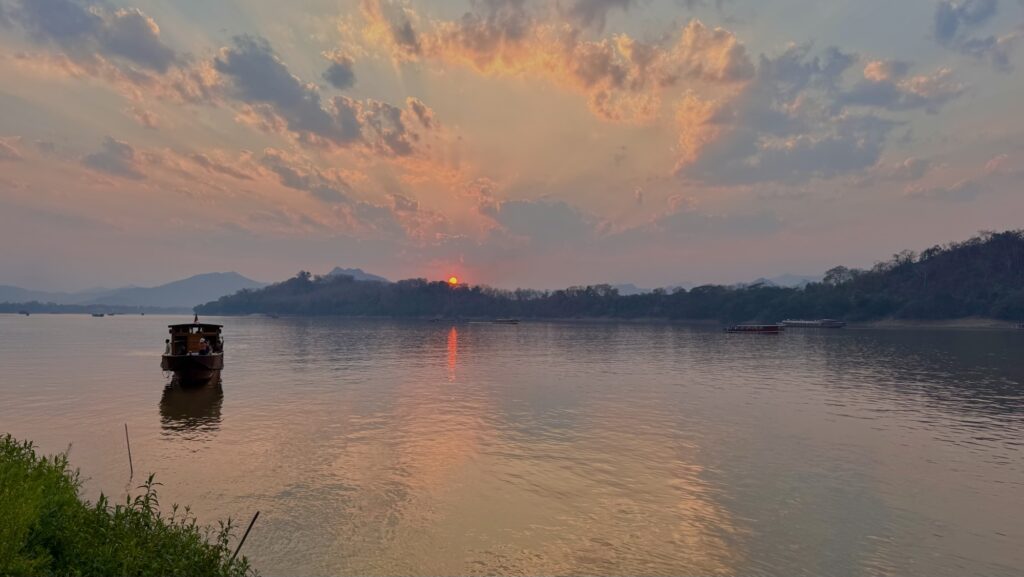
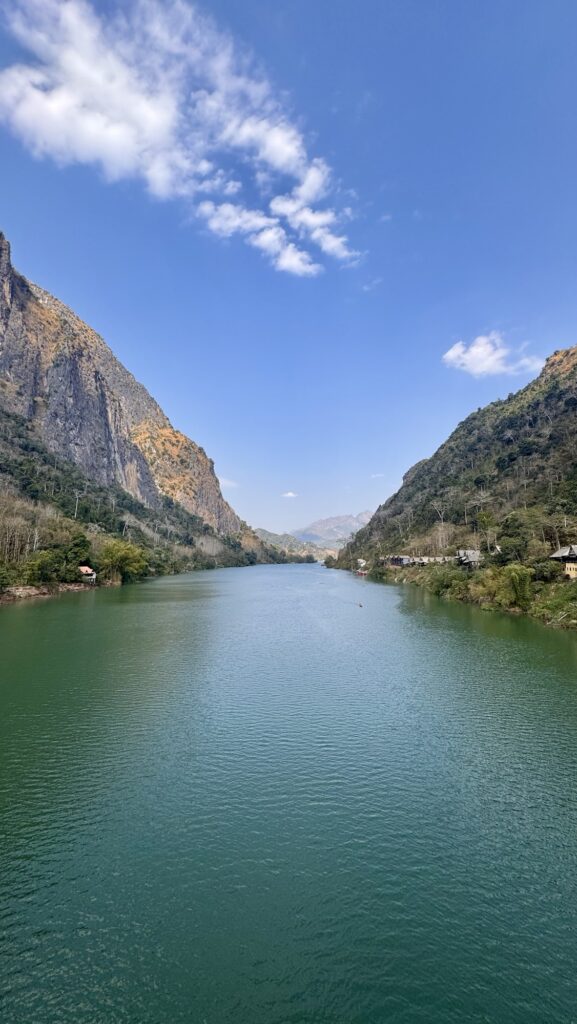
The city sits against the Mekong river, whilst the Nam Khan river meanders off to the east. Sunsets are wild, I found a prime spot all to myself on the banks of the Mekong, although there are also many bars and boats offering sundowner packages.
The Mekong River in Luang Prabang.
Restaurants, bars, and shops selling legitimate and less-legitimate copies of goods abound.
Tip: the stores on the main street, Sisavangvong Road, have a significant markup on products that you can also find in the covered Dara market off Ratsavong Road. Prices in the market are 40-50% less for the same, uh, brand name goods.
There’s a decent night market, rather nicer than others I’ve been to, and a separate night food market.
Renting a Motorbike
Let’s get down to business. You can of course rent a scooter from any of the many businesses offering them. Personally, I would not want to ride a scooter on the route I took. People do, and the locals of course use them everywhere, but again (and I promise I will explain why), I cannot fathom making this journey on a 110 or 125 Honda.
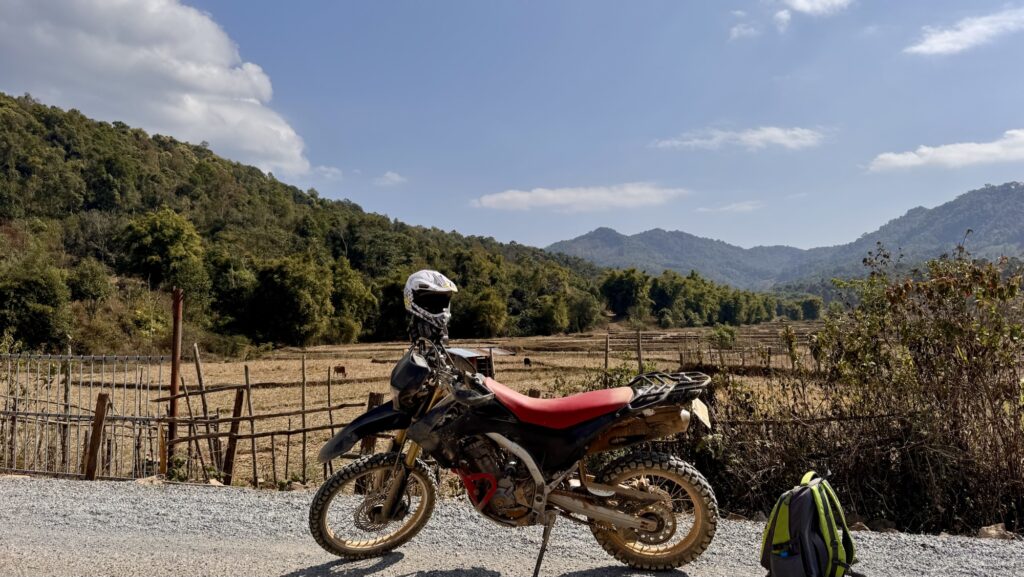
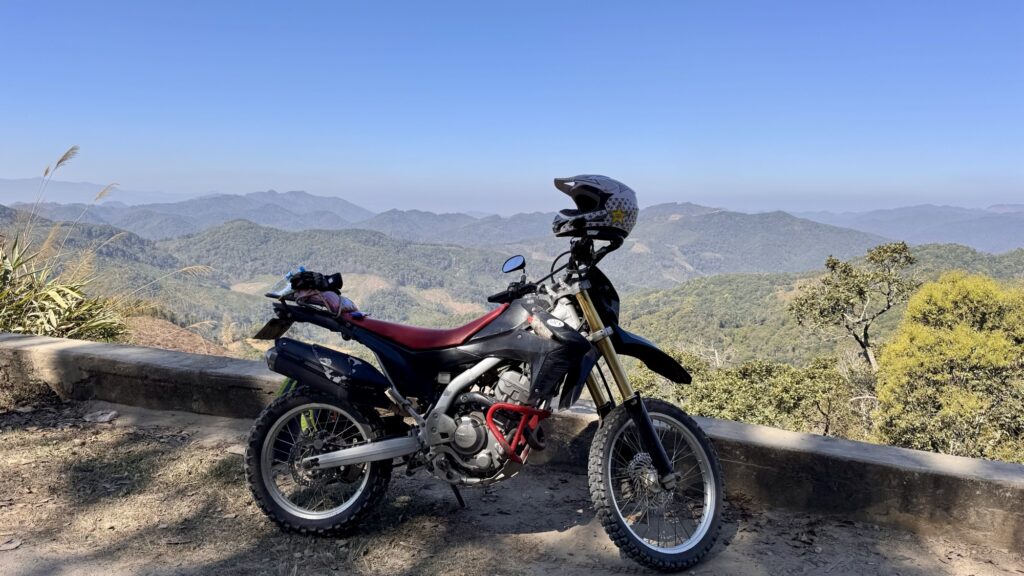
Instead, I recommend trading up to a trail bike. Mine was a Honda CRF250L, a bike I would trust to get me anywhere. I rented mine from Off-Roading Laos, and while I’m not being paid to write this, I highly recommend this company. Harry, the (British) owner, is personable, always responsive, reliable, funny, and was my near constant companion over WhatsApp.
Riding solo is a very different experience from riding in a group. You have to be prepared for anything and to get yourself out of sticky situations on your own. If that’s not for you, form a group and go together. There are similar companies offering similar bikes, with tour guides and accommodation all thrown in. You pays your money and…
Harry gave me a full rundown of the rental contract, was flexible on number of days hire (fortunately…) and even when we discovered that I’d cracked a bracket on the exhaust on return, didn’t charge me when he’d determined that a simple weld job would fix it. And of course, it wasn’t necessary to leave my passport: just a copy of it and my international driving licence.
Tip: get an IDP (of the right treaty date for the country, 1949 for Laos) otherwise you won’t be covered by any insurance policy.
Choose Your Route
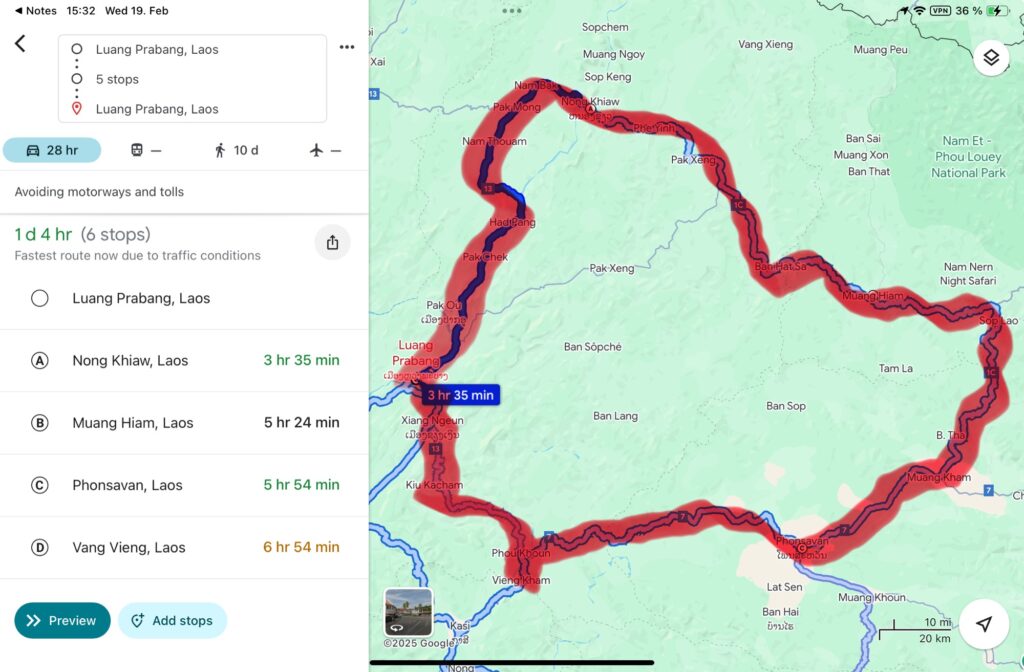
Here’s where my experience gets interesting. The typical loop from Luang Prabang goes clockwise:
I actually recommend doing it anti-clockwise, going to Vang Vieng first. Why? Well let’s talk about the elephant in the room.
The Roads
Think of a bad road near you. Maybe it has some potholes that you have to avoid, or the surface has been patched up one too many times. Maybe it’s a bit gravelly, or is more of a dirt track.
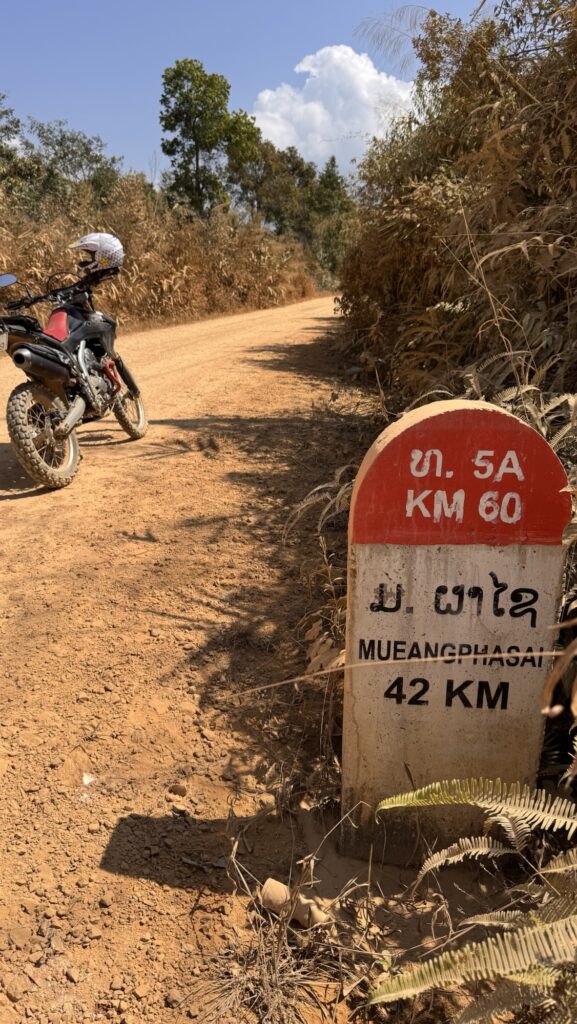
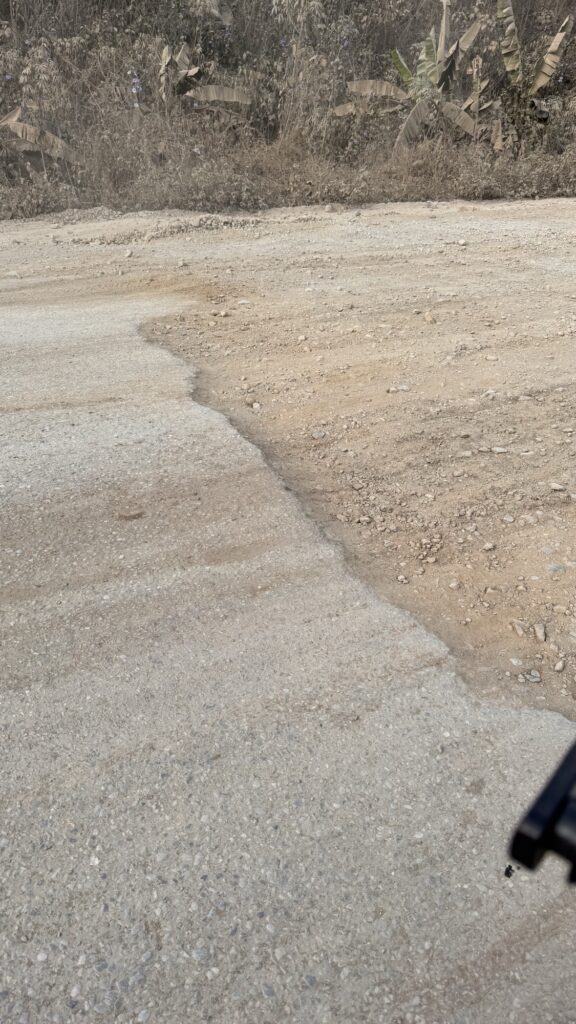
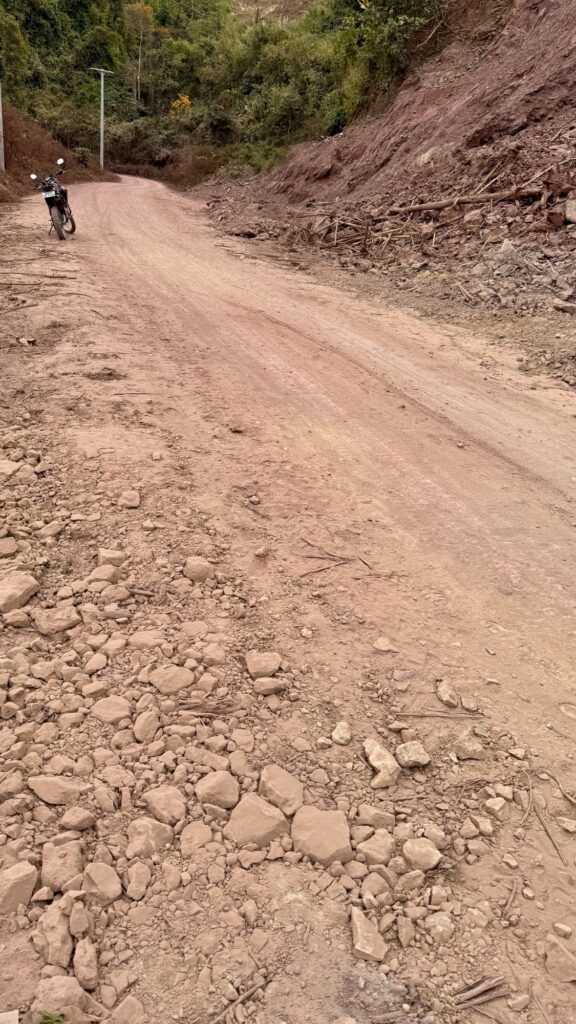
These are not the conditions you will find in Laos. Outside of the major cities (like, literally as you cross the limit), the roads crumble. Asphalt is missing for vast expanses, length and breadth. Craterous potholes drop the bike suspension from under you. Landslides have ripped away the road surface and replaced it with ground up sandstone, boulders and rubble.
Dirt track road outside Longcheng.
There are not many main roads in northern Laos – most of them are those on the map above. Therefore, they are used by all traffic, from scooters to AWD pickups to minibuses to ubiquitous Hyundai H-100 light freight to huge hulking 40-tonne articulated trucks.
Winding their way through the mountains on tight curves, these last heavy vehicles have ground away the road surface, to absolutely nothing in many places. You’ve not gone off-road, but these are off-road conditions.
However bad you are thinking it is, it’s worse. Northern Laos has the worst roads in “touristy” Southeast Asia. (I’m told the south is better but I can’t confirm).
From “Laos good” to “Laos standard”.
And then there’s the dust. Those trucks lumber slowly up and down, usually backing up into threes or fours that you will want to get past somehow. They kick up huge clouds of dust that will clog the bike’s air intakes, your air intakes, coat everything you are wearing, and blind your vision of what’s left of the road.
And then there’s the clouds. Up in the highest sections, you’ll be in the cloud. It’s cold, damp, and with 10-metre visibility.
Heading into the clouds at Nan.
And then there are the drivers. Those AWD vehicles are always speeding, badgering you to get out of their way. The Hyundai pickups are the same, only carrying human or animal cargo.
The truck drivers I found to be more accommodating – when they saw me, they would indicate to let me know it was safe to overtake.
You, on your motorbike, in unfamiliar conditions, are insignificant.
My Advice
Do not travel after dark.
Do not travel in shorts and a vest.
Do not travel without a helmet, gloves and other protective gear.
Do not wander off into the brush or forest; unexploded bombs still regularly kill people.
Do not even think about trying this route in the rainy season.
And with that all said, the reason I recommend the anti-clockwise route is that the last section, Nong Khiaw to Luang Prabang, is the shortest, and has approximately the best surface, and after all the other sections, you will want that sweet half-day to end on.
A Confession
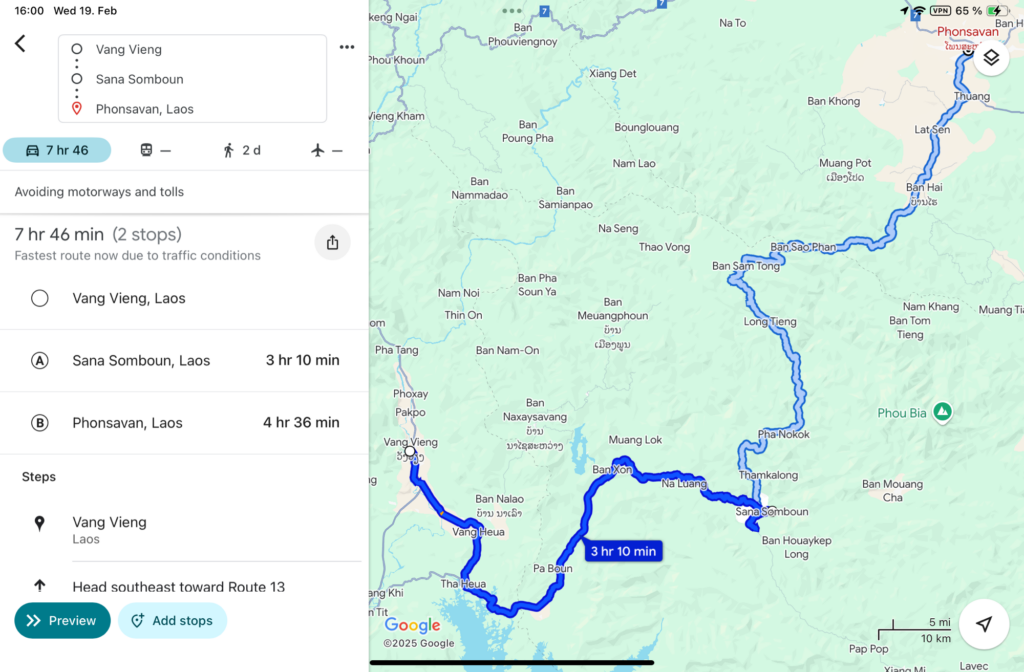
I didn’t actually take the route shown in the map. Between Vang Vieng and Phonsavan, Google actually suggests two options: north-ish on route 7, and south-ish on, well… water.
Route 7 is horrible. Trucks. Potholes. Boring.
The other route looks interesting.
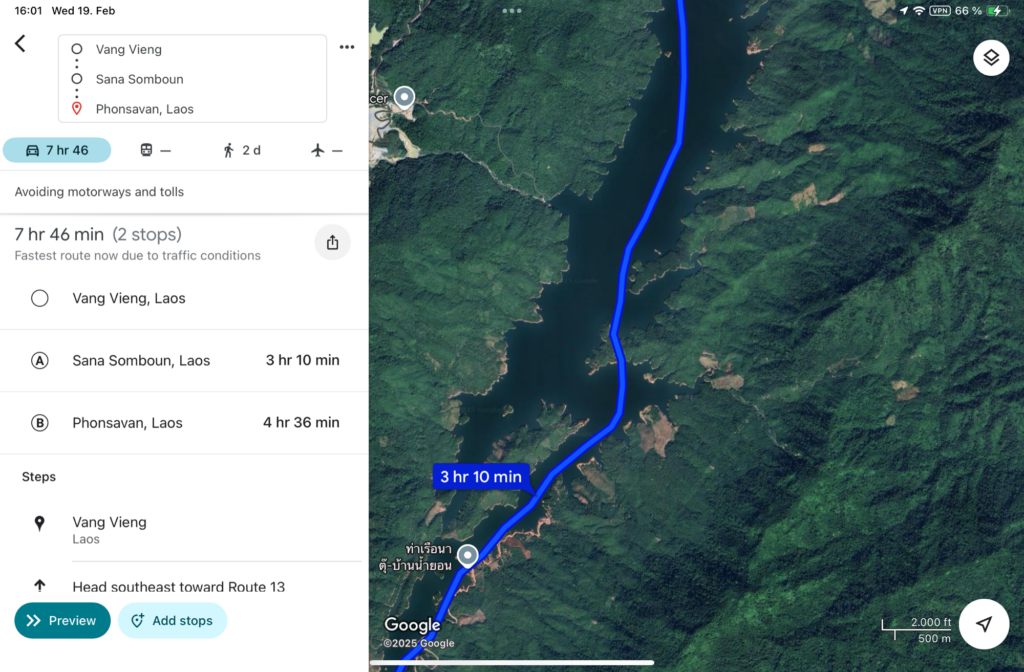
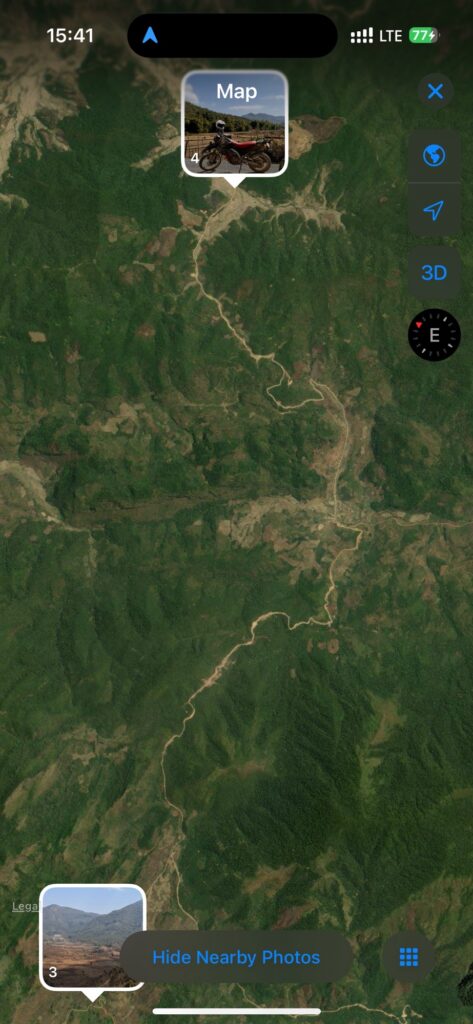
What Google fails to tell you, either by looking at the standard view or even in the detailed directions, is that a substantial portion of the first section is through a lake – Pa Boun to Na Luang. It’s roughly where the blue “3 hr 10 min” indicator is on the map above.
Only when you switch to satellite view and really zoom in does it become obvious. Google Maps thinks that a road goes through a lake.
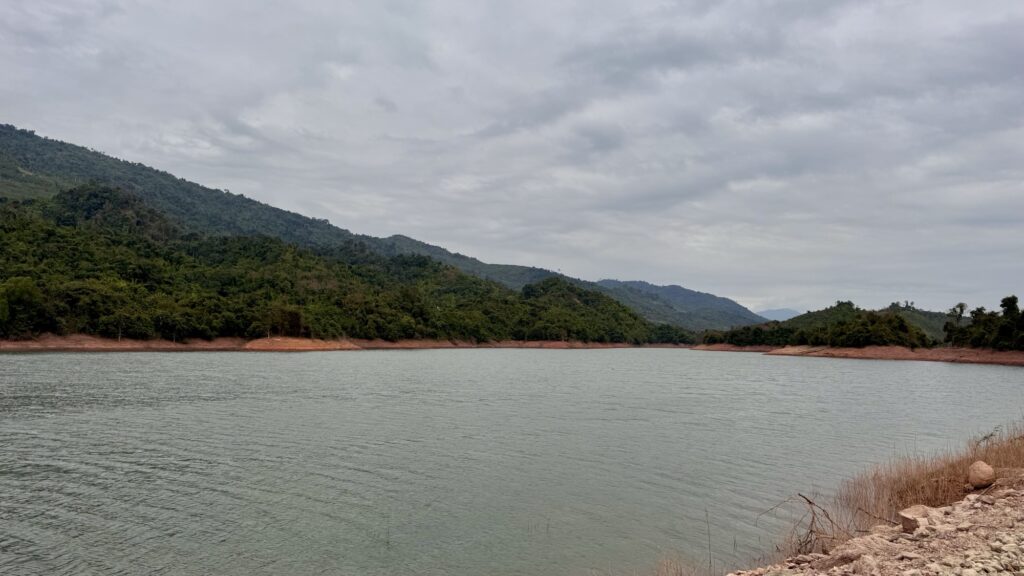
A road, according to Google Maps.
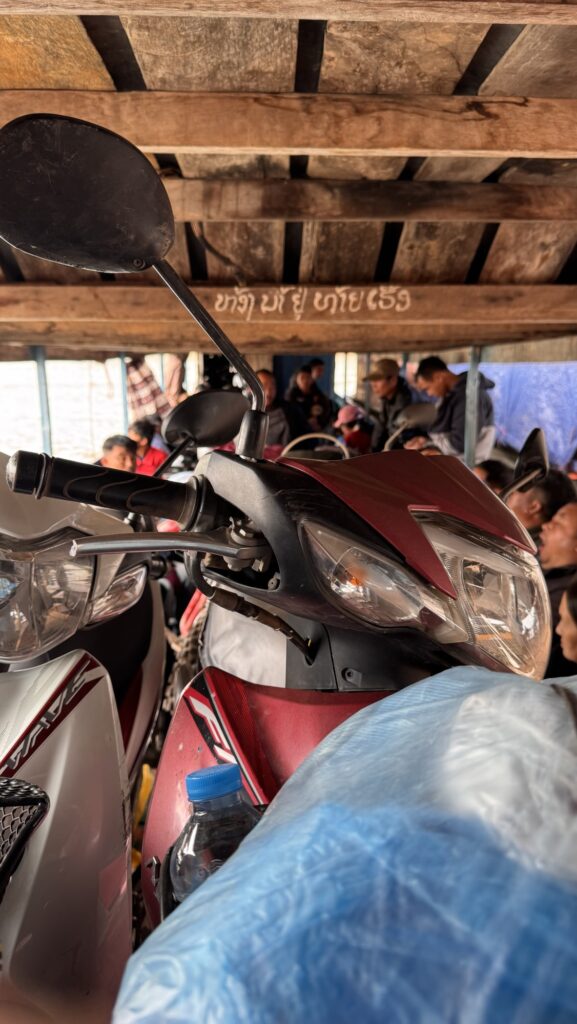
Had I known this, I might have stuck to route 7. Instead, I found myself and my bike loaded onto a longboat for a three-hour journey, that goes once a day at “midday” (Laos time approximation). It took me two days of solid eight-to-ten hour riding to get to Phonsavan.
My view on the longboat. Twenty bikes and fifty people.
Google Maps Tips
And so, here’s what I have to say about Google Maps in this part of the world.
Don’t trust it for anything.
Suggested travel durations are laughably short. Bank on at least 40% longer, even on the “sensible” routes.
Use two mapping apps. I used Organic Maps as a backup / confirmation source.
Use the “offline maps” features. While for the most part Laos has incredibly good LTE data coverage, it’s not universal and when you really need to check your progress, not having data is frightening.
Check both standard and satellite views, and zoom zoom zoom in to see what you’re really getting in to.
It Gets Worse
After the boat ride, an enforced stop in a tiny village (Sana Somboun) next to a massive gold mine was not what I was expecting to make, but since it was 5pm, I had to stop before dark.
Next morning, I set out to complete the section to Phonsavan, taking route 9303. You can tell by the numbering how minor this route is, but still it’s traversed (and ruined) by the trucks hauling ore from the gold mine.
The road after a landslide has been cleared.
Just when I thought the road could not get any worse, it disintegrated entirely into 20km of sand, high up in the mountains. It is exhausting riding a bike through sand, physically and mentally. I absolutely do not recommend it.
20 kilometres of sand.
But I had no alternative. And hence I was glad that my rental period from Harry was flexible, because after all that had happened, I needed two extra days – eight in total, not six – to complete this loop (including two much-needed rest days).
Hence my advice: route 7 might be terrible, but this was more terrible so don’t try it unless you’re an accomplished off-road dirt bike rider (which I feel a little like I am now).
All that said, there’s still a cracking sunset to be had en-route.
Sunset in Sana Somboun.
Where To Stay
In the bigger towns and cities you’ll have plenty of options at all price levels, so I’m obviously only saying where I stayed.
Luang Prabang: Museum Inn and Hotel. Lovely colonial-era frontage, excellent staff and very comfortable. Easy walking distance to the market areas, but then nowhere is very far away in the centre of the city. Good breakfast and great shower.
Vang Vieng: Camellia Hotel. Rather basic but clean. Very average breakfast and bad shower. You could do better but since I basically got there, ate, slept and left it was okay.
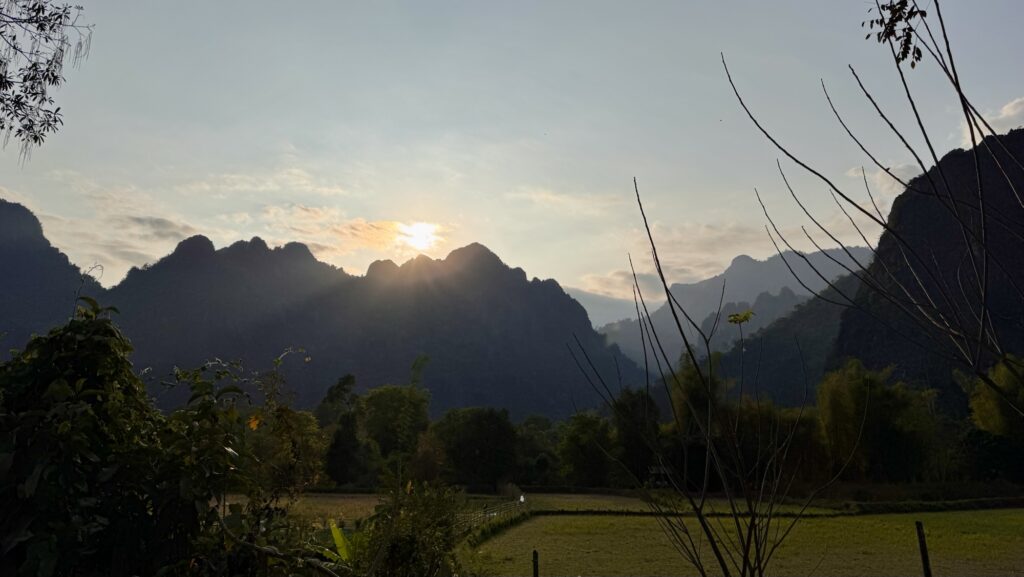
Sundown near Vang Vieng.
Phonsavan: Kongkeo Guesthouse. Amazing little bungalow affair, and while the facilities aren’t anything special (and no breakfast available), the owner Mr Kong is an absolute gem of a man, stoking the fire at night (it gets cold here) and telling stories. Highly recommended.
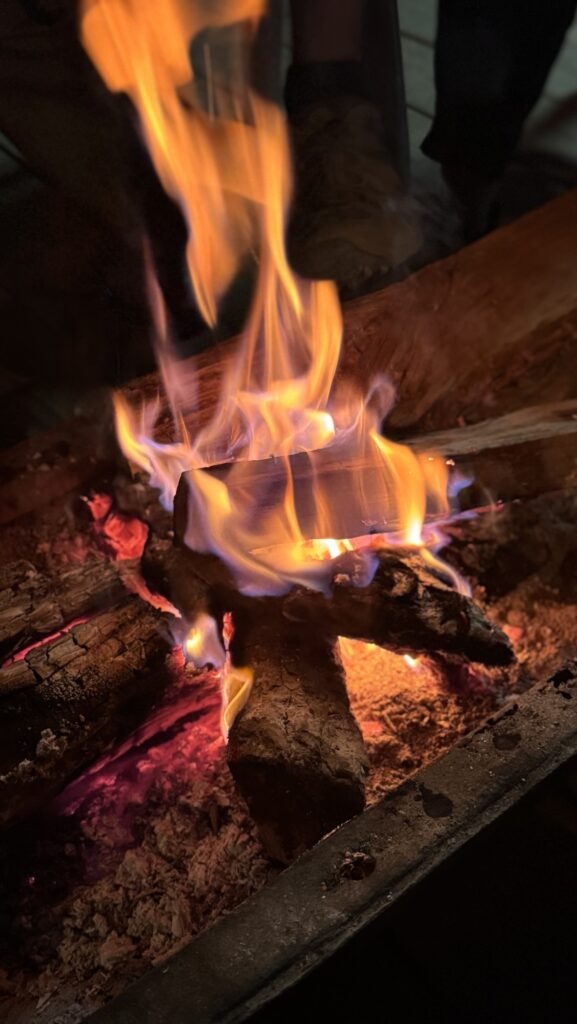
The very-welcome fire pit at Kongkeo Guesthouse. It’s made from two halves of a missile.
Muang Hiam: there’s not much choice here, so the Daonouar Guesthouse was my selection. It’s new, but also nothing special, just okay for an overnight. Terrible breakfast, sub-par shower. The reason for staying here is that across the road is a hot spring which is great to unwind in after a long journey.
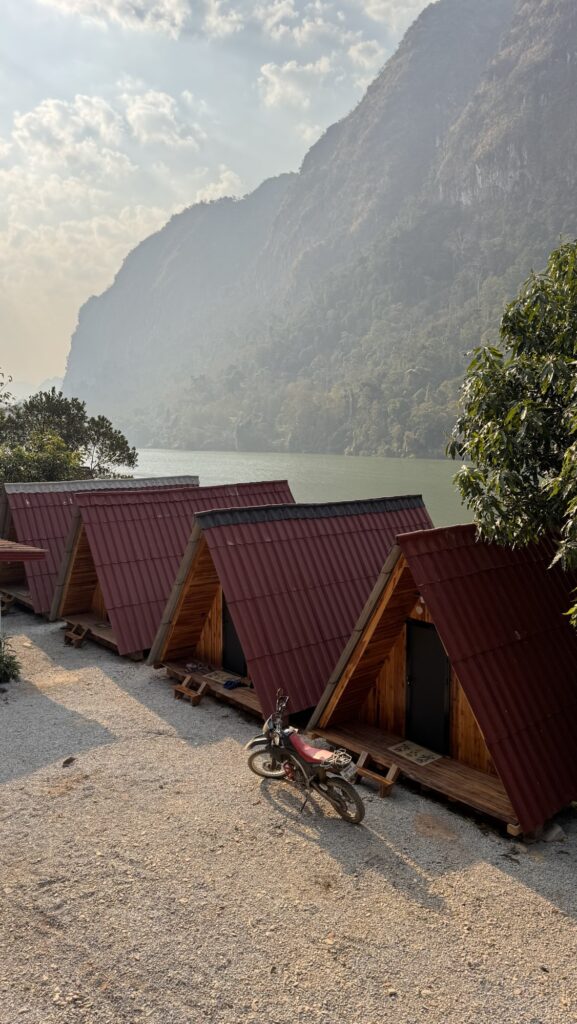
Nong Khiaw: Papaya Resort. “Resort” is a bit of a stretch but this is a new offering with sixteen bungalows looking out over the Nam Ou river, a beautiful setting offering great sunrise and sunset viewing. Great shower and a heated toilet seat (not sure why). There’s a restaurant attached for breakfast (not included) and other meals, and while the organisation is a bit chaotic, the food is really good. It’s a little way out of the town but only five minutes ride.
Papaya Resort in Nong Khiaw.
I also stayed at the Phousy Gueshouse near Sana Somboun as an emergency place during my wild two days avoiding route 7. Cheap, no breakfast or any fancy facilities. But needs must.
Fuel and ATMs
For the most part, fuel is not hard to come by. Every medium-sized town will have at least one petrol station. I tended to fill up at about half a tank but never came close to fuel anxiety. There’s no petrol station in Sana Somboun, but there are places selling (expensive, relatively) fuel by the litre bottle.
Just indicate to fill to the max, and the attendants know what to do.
For cash, again ATMs are not hard to come by in towns. There’s all kinds of fretting by reviewers about cards being swallowed or cash not delivered. “Don’t use a Visa card”, “Don’t use a Mastercard” are the contradictory statements. I had no problem whatsoever with my German Visa card or my Wise Visa card.
Above Kham.
Conclusion
This is not a tour for the faint-hearted. Each day is long, hot, dusty and you will ache for days afterwards. It’s not a relaxing experience, especially compared to other tours you may do in Europe or even Thailand or Vietnam.
You will see unsettling amounts of poverty and terrible living conditions. But you will also see grand vistas of nature around every corner. You will constantly be waving at little kids who rarely see a foreigner. You will gain riding experience like no other. You will love it and hate it. You will be changed by it.
And you won’t forget it.
Those Views
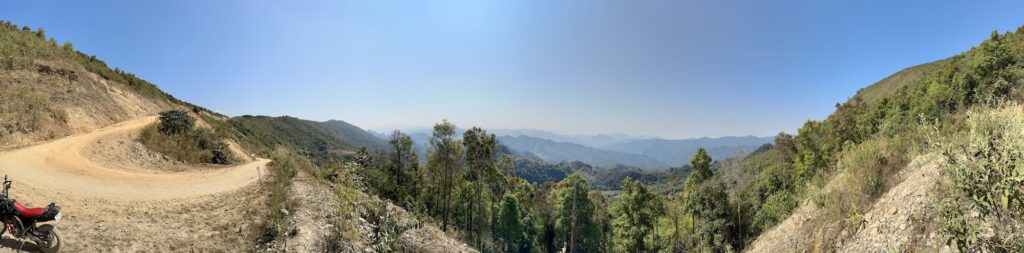
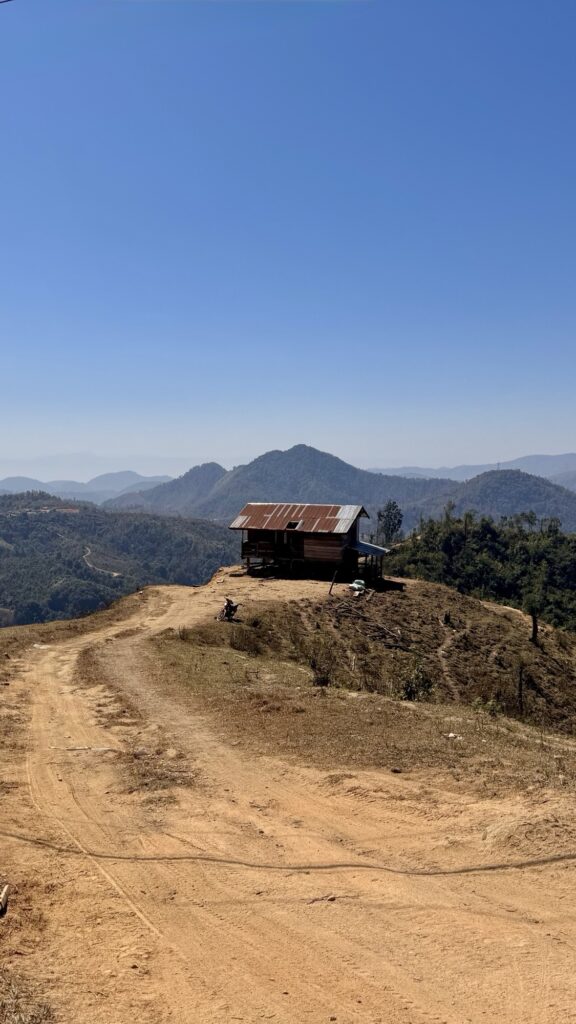
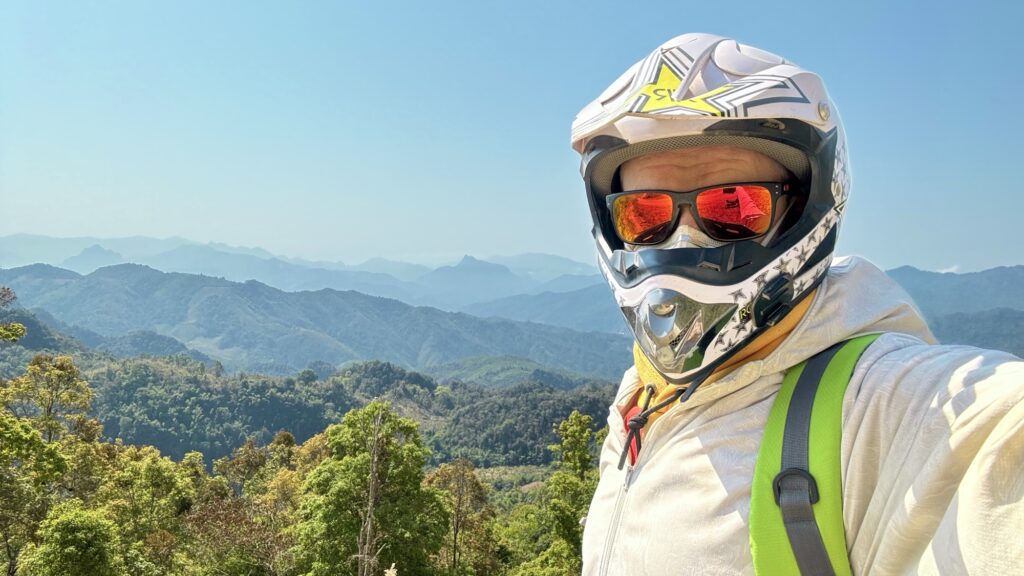
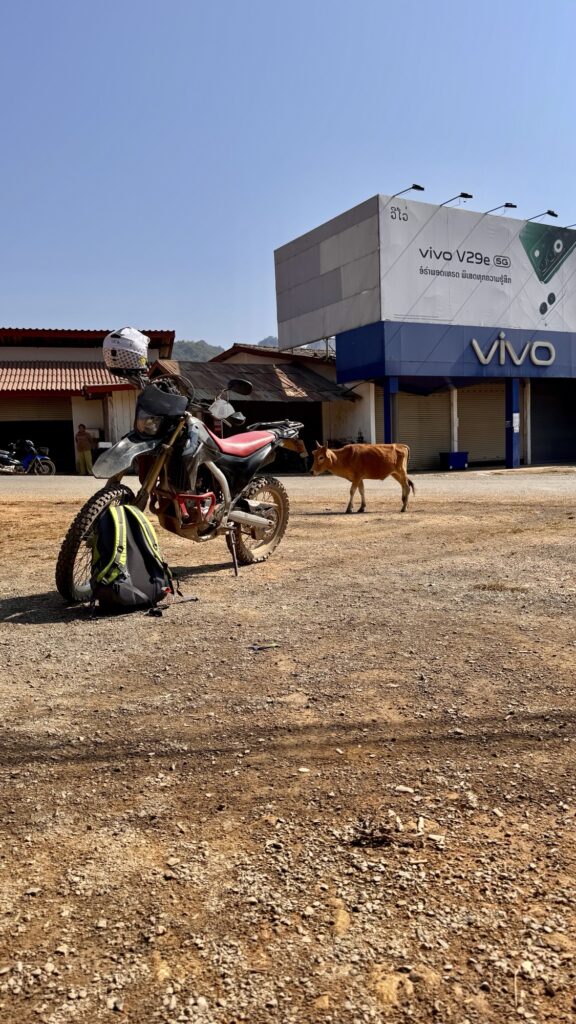
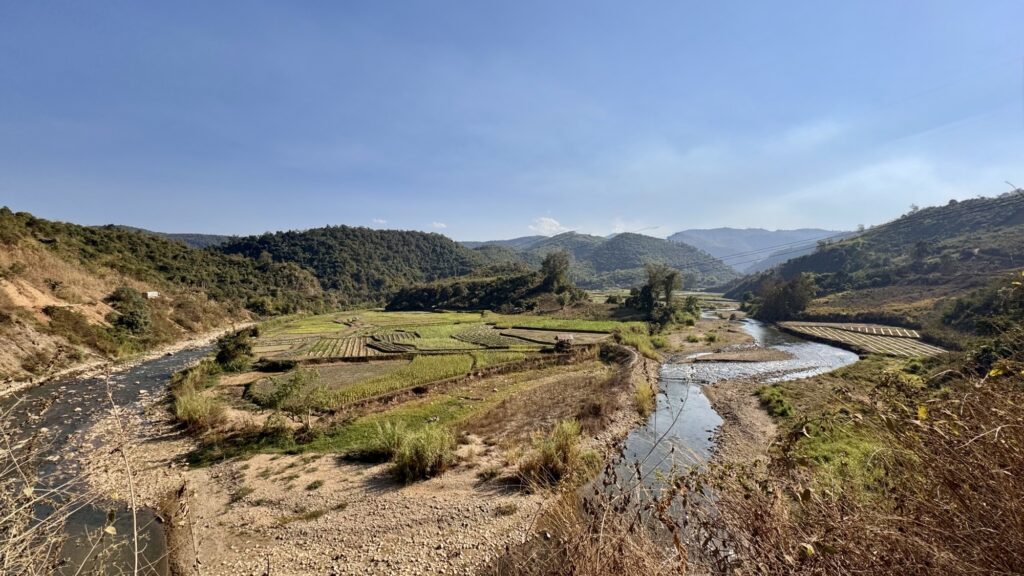
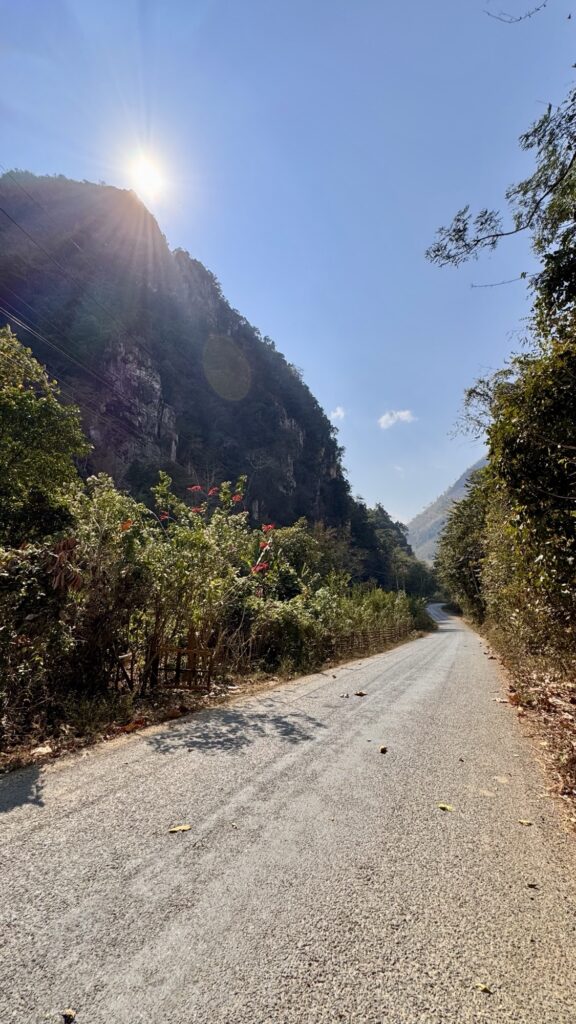
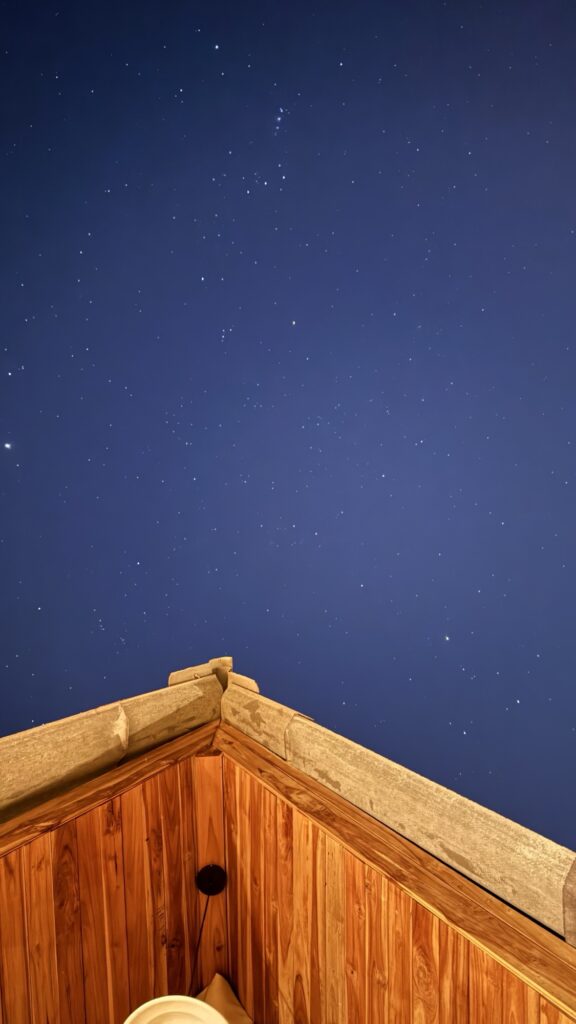
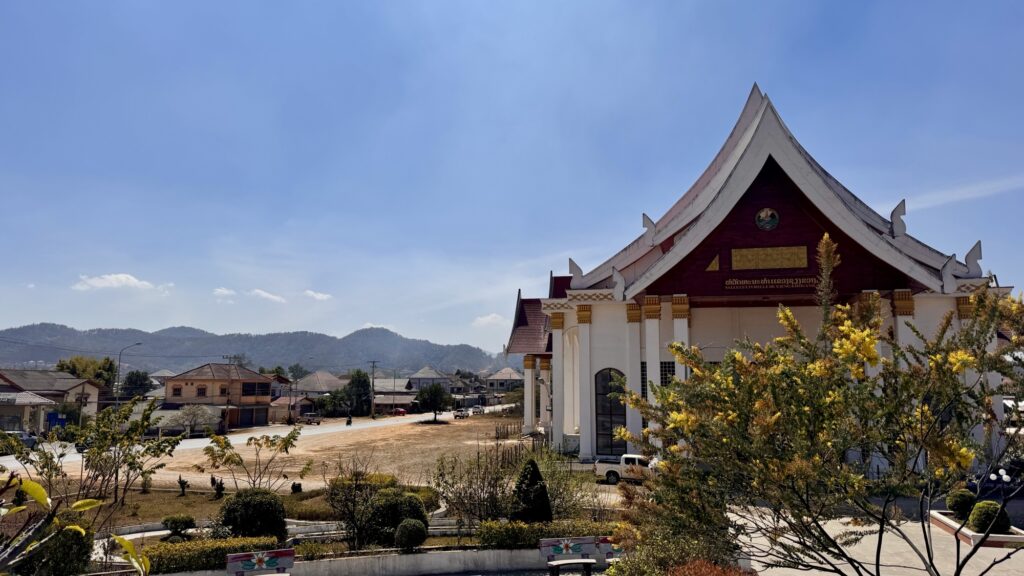
Nong Khiaw. Room with a view, above Kham. On top of the world, above Longcheng. Modern technology, a motorbike, and a mobile phone advertisement. River valley near Huameuang. Approaching Nong Khiaw. Route 1C is notably good here. Orion is in there somewhere. Cultural Hall in Phonsavan.
Despite Because of my second-place win at the pub quiz last night I’ve been feeling a little under the weather today.
And looking at today’s post number, it’s rather obvious why: I haven’t had a day since I started all this when I haven’t had at least one beer.
Oops.
I’m not turning into a raging alcoholic but I rather forgot that I’m on a six-week journey not a week in the Canaries.
So I’ve had a day off today, and will do tomorrow and probably Friday (which is a travel day anyway) and give my processing organs a rest.
I eventually dragged myself out to get some food around the corner and then remembered about the “canalside night market” about twenty minutes walk away.
Wasn’t really all that special, a rather grotty canal with various stalls and cafe bars alongside it.
But also some more aloof cats (I know, all cats are aloof but Chiang Mai cats are the aloofest).
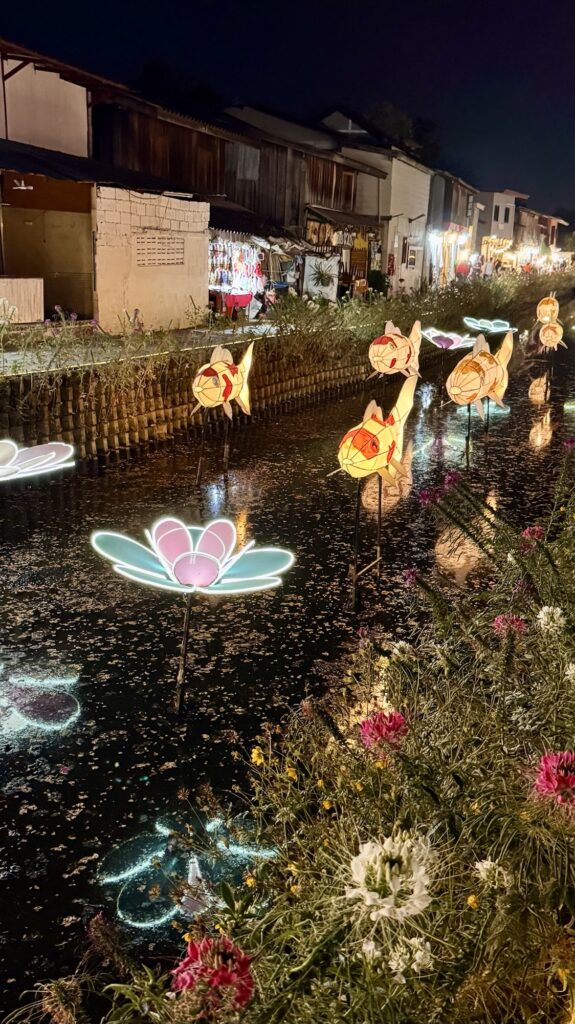
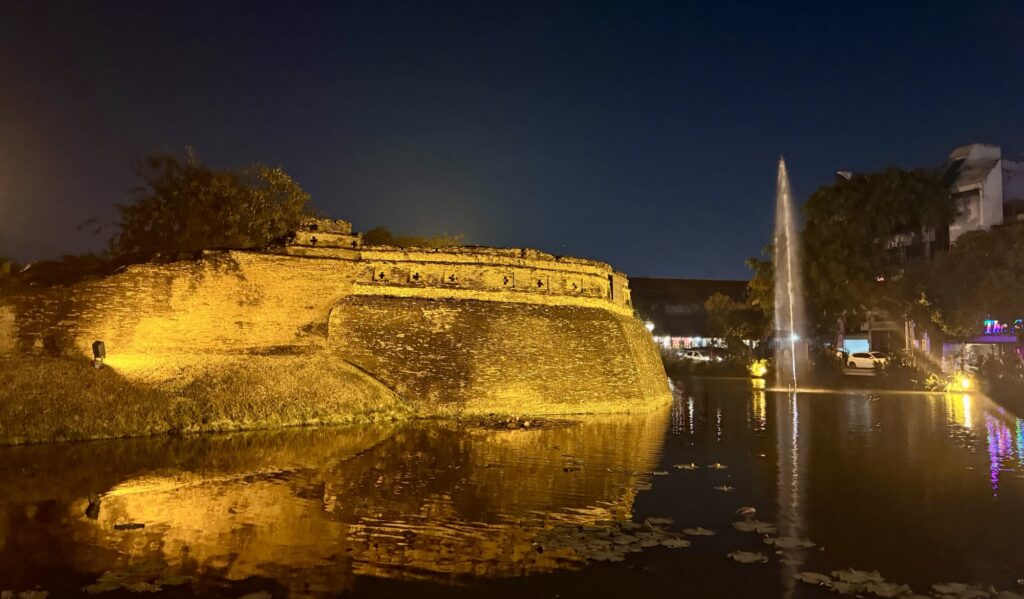
Illuminated fish floating above the canal. I doubt there are any in the canal. And some wall (part of what’s left of the original city wall). A kind of moat runs around the entire old city.